
Adding Powerwall 3 and Tesla Powershare Home Backup in Texas usually means three approvals: an interconnection application with your utility (even with no solar), an electrical permit and inspection from your city, and a scheduled power shutoff for install day. What each step looks like depends on whether you’re on a city-owned utility (Austin Energy, CPS Energy), a company that owns the lines and meter in an area where you pick your electricity provider (CenterPoint, Oncor, AEP Texas, TNMP) or a co-op (PEC, Bluebonnet, CoServ, GVEC). Below, each one side by side, from published utility and city documents.
Why a battery with no solar still needs the utility
Powerwall 3 doesn’t just sit idle until the power goes out. It’s connected to the grid all day, charges from it, and can power the home alongside it. Utilities count that as running “in parallel.” Oncor’s installer page says a battery that runs in parallel with the grid “for any length of time” needs an interconnection agreement. AEP Texas says state rules require energy storage running in parallel to be reviewed and approved.
There’s one exception you may hear about. A backup-only system that never runs in parallel is treated differently. PEC, for example, sends those through its standby-generator rules instead. That isn’t how a normal Powerwall 3 and Powershare install is set up, so plan on filing an interconnection application.
Utility-by-utility comparison
In Houston, Dallas–Fort Worth and much of South Texas, two companies share the job. One owns the poles, lines and your meter (CenterPoint, Oncor, AEP Texas or TNMP), and that is who approves batteries and who we call for the shutoff. The other is the electricity provider you pick, who sends the bill. Austin Energy, CPS Energy and the co-ops do both. “Check with your utility” means the utility doesn’t publish that detail.
| Utility (type) | Interconnection for Powerwall 3 | Install-day shutoff | Battery programs (as published) |
|---|---|---|---|
| Austin Energy (city-owned) | Auxiliary-power DGPA filed with the City of Austin permit. Under 25 kW (one or two Powerwall 3 units) Austin Energy approval isn’t needed; 25 kW and up goes to Austin Energy for review. No PV meter without solar. Austin Energy Solar Inspections does a rough and a final inspection. | We call in the shutoff with Austin Energy before install day. Registered contractors can use its Contractor Disconnect Program: Wednesdays only, up to 12 outages a week, $165 completeness check on the permit. Otherwise Austin Energy schedules the disconnect. Book early; check with your utility on lead time. | Power Partner Battery: $500 upfront plus $75 per kW-year performance pay. No solar needed. Powerwall 3 is eligible. Participating contractor required. |
| CPS Energy, San Antonio (city-owned) | DG application emailed as a PDF with a one-line diagram, site plan and elevation. Review takes 20 to 25 working days. CPS says its DG manual is being revised for batteries; battery questions go to its DG section. CPS approval is preferred before the city permit. | CPS performs the outage. It’s added to the city permit as a “Work with CPS” line item. Lead time: check with your utility. | My Battery Rewards: $10 bill credit per event. |
| CenterPoint, Houston (owns the lines and meter) | Installer applies through CenterPoint’s online interconnection portal: design review, build, final review, then Permission to Operate (PTO). The public page covers solar; battery-only details: check with your utility. | We call in the shutoff with CenterPoint first; then our licensed electrician can cut the outer seal and pull a 240 V self-contained meter. The requested date must be two business days out, the work window is 48 hours, and any lock band must be removed first. CenterPoint reseals afterward. | No residential battery rebate. Retail-provider VPPs (such as Tesla Electric) may apply. |
| Oncor, DFW (owns the lines and meter) | Installer Portal (training guide: “DERTRACK”). Parallel operation for any length of time needs an interconnection agreement. Oncor reprograms the meter. | We call in the shutoff with Oncor before install day. | No residential battery rebate found. Retail-provider VPPs may apply. |
| AEP Texas (owns the lines and meter) | PowerClerk. Storage in parallel must be reviewed. You get an Interconnection Service Agreement, then PTO. Equipment must meet IEEE 1547-2018 and have a visible, lockable disconnect. | We call in the shutoff with AEP Texas before install day. | No residential battery rebate found. Retail-provider VPPs may apply. |
| TNMP (owns the lines and meter) | PowerClerk. One-line and site plan with your ESI ID and meter number. You confirm the application by email. TNMP issues a Letter of No Objection and charges a $227 meter change fee. The public page doesn’t mention batteries: check with your utility. | We call in the shutoff with TNMP before install day. | No residential battery rebate found. |
| Pedernales Electric Co-op (PEC) | PowerClerk. Batteries go on the one-line, and battery inverter kW counts toward system size. $500 fee under 50 kW. Final inspection target 10 to 15 business days. Lockable, labeled disconnect within sight of the meter or a placard. | We call in the shutoff with Pedernales Electric Co-op before install day. | No member battery program found. Check with your utility. |
| Bluebonnet Electric Co-op | Interconnection packet with an “Under 50 kW, Inverter Based Solar and/or Battery only” worksheet, emailed to the co-op. Visible-break disconnect, co-op inspection and back-feed test. | We call in the shutoff with Bluebonnet Electric Co-op before install day. | No battery program found. Check with your utility. |
| CoServ (co-op) | Not published for batteries. Check with your utility. | We call in the shutoff with CoServ before install day. | PeakTime Perks: $30 a month per eligible Powerwall 3 (up to $360 a year), up to 250 event hours a year, 20% reserve kept. Expansion units not eligible. |
| GVEC (co-op) | Valid Interconnection Agreement required for its battery program. | We call in the shutoff with GVEC before install day. | Peak-Time Payback: sign-up incentive plus $75 per kW-year ($1,725 a year for our standard two Powerwall 3, $862.50 for one). Tesla lists $8,452.50 upfront for two Powerwall 3 ($5,922.50 for one) installed after April 1, 2026, with a five-year commitment; GVEC’s own page still shows $220 per kW. Confirm with GVEC. |

Deregulated areas: your utility vs your retail provider
In Houston, most of DFW and AEP Texas or TNMP territory, two companies serve you. The company that owns the lines (CenterPoint, Oncor, AEP Texas or TNMP) owns the poles and the meter. It handles interconnection, meter pulls and PTO. Your retail electric provider sends the bill and sets any buyback rate or VPP credit.
Tesla Electric is one retail option with a VPP for Powerwall owners in ERCOT. It pays a monthly bill credit, with or without solar. It requires a valid interconnection agreement, and it only runs where Tesla has set up an aggregation in your area. Austin Energy, CPS Energy and the four co-ops aren’t open to retail choice, so their own programs are the ones that apply.
Powershare Grid Support isn’t available for Model 3/Y
Powershare backs up your home with the car. Getting paid to send the car’s energy back to the grid (Powershare Grid Support) isn’t offered for Model 3 or Model Y. Cybertruck has an invite-only Texas pilot. There’s also no federal tax credit for systems installed in 2026.
City permits: what each big city requires
Two 2025 state laws changed battery permits on Sept. 1, 2025. SB 1252 bars cities from regulating how residential backup systems up to 50 kW or 100 kWh are installed or inspected. City-owned utilities like Austin Energy and CPS Energy can still set their own rules. SB 1202 lets a qualified third party (a master electrician, a certified inspector or an engineer) review and inspect home backup systems. Cities still permit and inspect the service-side work: main disconnect, grounding and bonding, the Gateway, and any panel changes.
Code basics: Texas adopted the 2026 NEC as the state electrical code on Sept. 1, 2026. NEC Article 706 covers energy storage systems, and Article 705 covers equipment tied to the grid. Fort Worth’s 2026 amendments add an outdoor emergency shutdown switch for home battery systems.
| City | Permit and code | Published fees | Inspections |
|---|---|---|---|
| Austin | Auxiliary-power electrical permit through Austin Build + Connect. 2026 NEC, 2024 IRC and IFC. Fire Department review if one unit is over 20 kWh or the total is over 80 kWh. | Permit base fee $111.66 plus $74.44 battery inspection under 15 kW (about $186 for one Powerwall 3); $148.89 inspection at 15 to 30 kW (about $261 for our standard two Powerwall 3 at 23 kW). DSD schedule effective Oct. 1, 2024; check for updates. | Austin Energy rough inspection before anything is covered, then a final with a master or journeyman electrician on site. |
| Houston | Electrical permit in iPermits. The city doesn’t inspect the battery or inverter itself (SB 1252). A TCI/reconnect permit releases power back to CenterPoint. Third-party option uses forms CE-1416 to CE-1418. 2026 NEC since Sept. 1, 2026. | $91.06 minimum fee plus $33.56 admin fee per permit (about $125). No battery-specific fee published. | City inspection for the service release; battery side by city or third party per the pathway chosen. |
| San Antonio | BuildSA portal, filed as a SOLAR-type permit for any backup system (IB 250). Plans sealed by a master electrician or engineer, with a load calculation. CPS release is needed before turn-on. | $50 basic inspection, $100 plan review (waived with third-party review), $2.15 add-on if a CPS outage is needed. | City or third-party inspections, then CPS release for commissioning. |
| Dallas | The city doesn’t review or inspect the backup portion (SB 1252). A standalone electrical permit is still needed for service, panel, disconnect or grounding changes (SFB #204). | $196 standalone electrical permit ($181 plus $15 tech fee) and a $100 trade inspection fee. A $577 plan review applies when building, zoning or fire review is triggered; check whether your job triggers it. | Premise-wiring inspection by the city, or third party if chosen. |
| Fort Worth | 2026 NEC with local amendments, effective Sept. 1, 2026, including an outdoor emergency shutdown device for home ESS. 2021 IRC and IFC. | No battery fee published. Check with the city. | Not published for batteries. Check with the city. |
| Suburbs and unincorporated areas | Each suburb runs its own process under the same state laws. In unincorporated county areas there’s often no city electrical permit at all. Check with your county and HOA. | Varies widely. | The utility’s own inspection and PTO still apply. |
Where Powerwall 3 can go: fire code basics
Home battery placement follows IRC R328 and NFPA 855 Chapter 15, plus Tesla’s install manual. The rules that decide most Texas installs:
- Listed to UL 9540. Each unit max 20 kWh (Powerwall 3 is 13.5 kWh).
- Up to 80 kWh total in a garage, on an exterior wall or outdoors; 40 kWh in utility closets and storage rooms. Bigger systems need UL 9540A test data and local approval.
- 3 feet from doors and windows that open directly into the living space (NFPA 855, 2023 edition).
- Units 3 feet apart unless test data allows less. Tesla’s manual allows 4 inches side by side (6 inches recommended).
- Tesla clearances: 12 inches in front for airflow, 4 inches on each side, 2 inches on top, and 36 inches of working space in front per NEC 110.26. The feet must sit no higher than 45 inches.
- In a garage, a barrier if the unit is in a vehicle’s path. Indoors, interconnected heat detection and drywall rules apply.
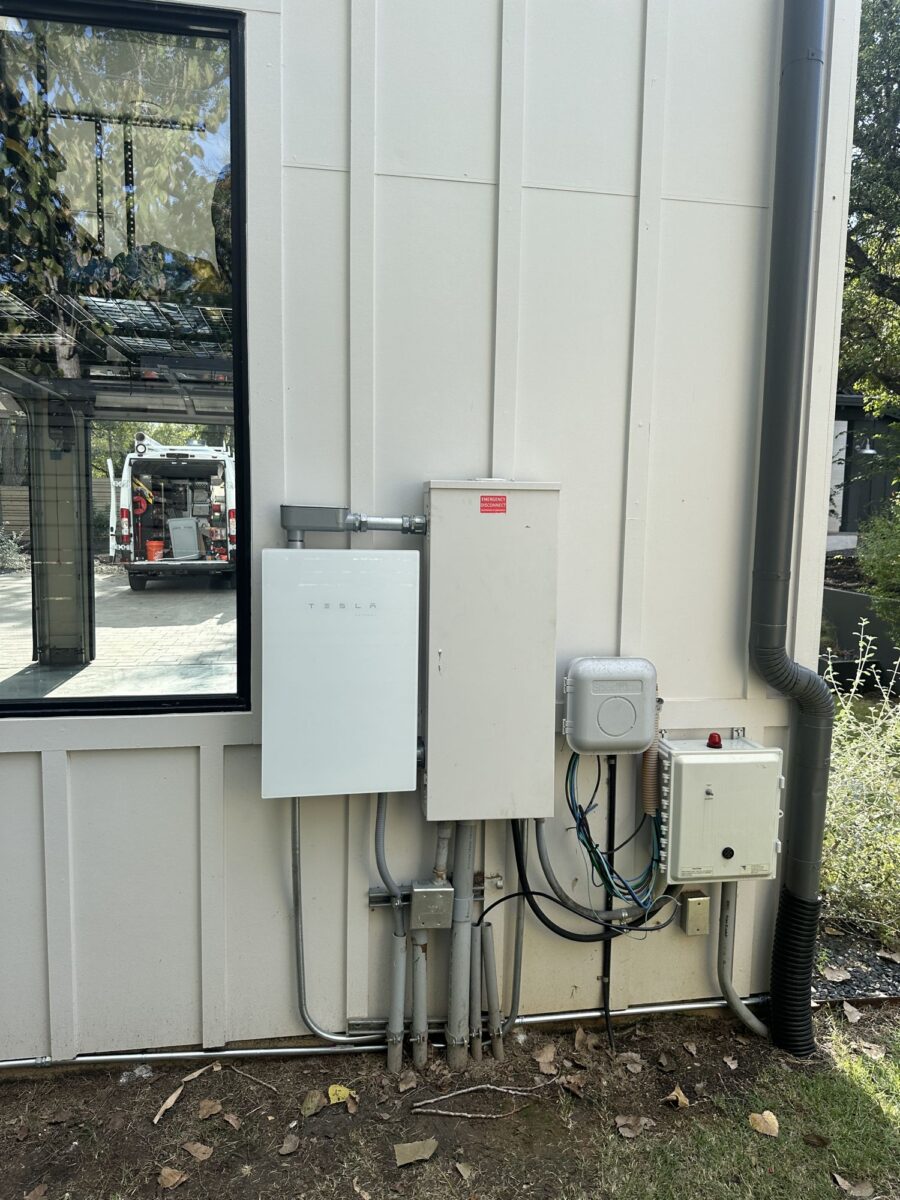
What we handle for you
Paperwork
We file the utility interconnection application and pull the city permit. You sign where the utility requires the homeowner’s signature, nothing else.
The shutoff
Wherever we pull a meter, we call in the shutoff with your utility first, inside its notice rules. That way the install happens in one visit and the utility always knows the power is off.
Inspection
We meet the inspector. If an inspection fails, we fix it. That’s our inspection-pass guarantee.
Our own electricians do all the electrical work, never subcontractors, and our master electrician still goes out on installs. Charge Pro Texas holds TECL #37972 and is a Tesla Certified Installer. See our Tesla Powershare installation page for what’s included.
Install-day timeline
- Quote from photos. Usually the same day, no site visit needed. A site visit is $250, credited to the install.
- Applications. Interconnection application and permit go in together. Utility review can take weeks (CPS publishes 20 to 25 working days).
- Book the shutoff. CenterPoint needs two business days’ notice; Austin Energy’s contractor program runs on Wednesdays. Other utilities: we confirm.
- Install day, morning. Walkthrough, power off, Powerwall 3 and Gateway 3 mounted and wired, Wall Connector on its own dedicated circuit on the backed-up side.
- Install day, afternoon. Power restored, system commissioned in the Tesla app, backup tested. Most Powershare installs take one day; a complex job occasionally takes two.
- Inspection and PTO. City or third-party inspection, then the utility’s Permission to Operate. Powershare is then switched on with Tesla. Activation can take a little while after install; we stay on it until it shows in your app.
- Programs. Enroll in your utility’s battery program, if it has one, once you have PTO.
Your area: Austin, Houston, Dallas-Fort Worth, San Antonio and the Hill Country. Austin Energy customers: read our Austin Energy Power Partner Battery guide, and our Texas virtual power plant guide for the rest of the state. Driving a Model 3 or Y? See Model 3/Y Powershare home backup.
Frequently asked questions
Do I need utility approval for Powerwall 3 if I don’t have solar?
Usually, yes. Powerwall 3 runs in parallel with the grid, and utilities like Oncor and AEP Texas require an interconnection agreement for any battery that does. Programs such as Tesla Electric’s VPP and GVEC’s Peak-Time Payback also require one.
Who turns off the power on install day?
It depends on the utility. In CenterPoint territory a licensed electrician can pull the meter after giving two business days’ notice. Austin Energy lets registered contractors do Wednesday disconnects. CPS Energy performs the outage itself. Wherever we pull a meter, we call in the shutoff with your utility first.
Does my city still inspect a home battery after the 2025 laws?
For systems up to 50 kW or 100 kWh, SB 1252 stops cities from regulating the battery install itself, but service-side work like the main disconnect, grounding and panel changes still gets permitted and inspected. Austin Energy and CPS Energy are city-owned utilities and can still set their own rules.
Is there a CenterPoint or Oncor rebate for home batteries?
No. CenterPoint has no residential battery rebate, and we found no published Oncor one. In those areas, battery income comes through retail-provider programs such as Tesla Electric’s VPP.
Which Texas utilities pay for Powerwall 3?
Austin Energy (Power Partner Battery, $500 upfront plus $75 per kW-year), CPS Energy ($10 per event), CoServ ($30 a month per Powerwall 3) and GVEC (sign-up incentive plus $75 per kW-year). Confirm current terms with your utility before you count on them.
Can my car earn money through Powershare?
Not with a Model 3 or Model Y. Powershare Grid Support isn’t available for them. Cybertruck has an invite-only Texas pilot. Utility battery programs pay for Powerwall 3, not the car.
Let us handle the utility and the permit
Send a few photos of your panel and meter, and we’ll tell you what your utility and city require, usually the same day.
Sources
- Power Partner Battery (Austin Energy)
- Distribution Interconnection Guide (Austin Energy)
- Contractor Disconnect Program (Austin Energy)
- Residential Fee Schedule (City of Austin Development Services)
- Building Technical Codes (City of Austin)
- Distributed Generation (CPS Energy)
- Distributed Generation Manual (CPS Energy)
- My Battery Rewards (CPS Energy)
- Connecting Your System to the Grid (CenterPoint Energy)
- Service Standards (CenterPoint Energy)
- For Installers (Oncor)
- Distributed Energy Resources (AEP Texas)
- Interconnecting (TNMP)
- Solar and Distributed Generation (Pedernales Electric Cooperative)
- Interconnection Process (Pedernales Electric Cooperative)
- Interconnection Packet (Bluebonnet Electric Cooperative)
- PeakTime Perks: Tesla Battery Program (CoServ)
- GVEC Virtual Power Plant (Tesla)
- Peak-Time Payback (GVEC)
- Tesla Electric Virtual Power Plant (Tesla)
- Powershare Support (Tesla)
- SB 1252 Changes to Residential Energy Backup System Regulations (TDLR)
- Commission Adopts Rules (2026 NEC) (TDLR)
- Upcoming State Law Changes for Residential Backup Power Systems (Houston Permitting Center)
- Process Updates for Residential Backup Power Systems (Houston Permitting Center)
- Electrical Building Permit Application CE-1057 (City of Houston)
- 2026 NEC Effective September 1, 2026 (Houston Permitting Center)
- IB 250: Home Backup Power Review and Inspections (City of San Antonio DSD)
- SFB #204 Residential Backup Power (City of Dallas)
- Building & Energy Codes (City of Fort Worth)
- 2026 NEC Amendments (draft) (City of Fort Worth)
- SB 1252 Residential Backup Systems (City of Sugar Land)
- ESS Separation and Maximum Quantities, 2021 Residential Requirements (UL Code Authorities)
- NFPA 855 Locations for Energy Storage in Dwellings (HeatSpring)
- Powerwall 3 Clearance Requirements (Tesla)
- Common Mounting Restrictions (Tesla)