
Ask three people and you will get three answers. Tesla’s install manual says not to use one. Older forum posts say a 60-amp circuit does not need one. Texas inspectors are now asking for one by name.
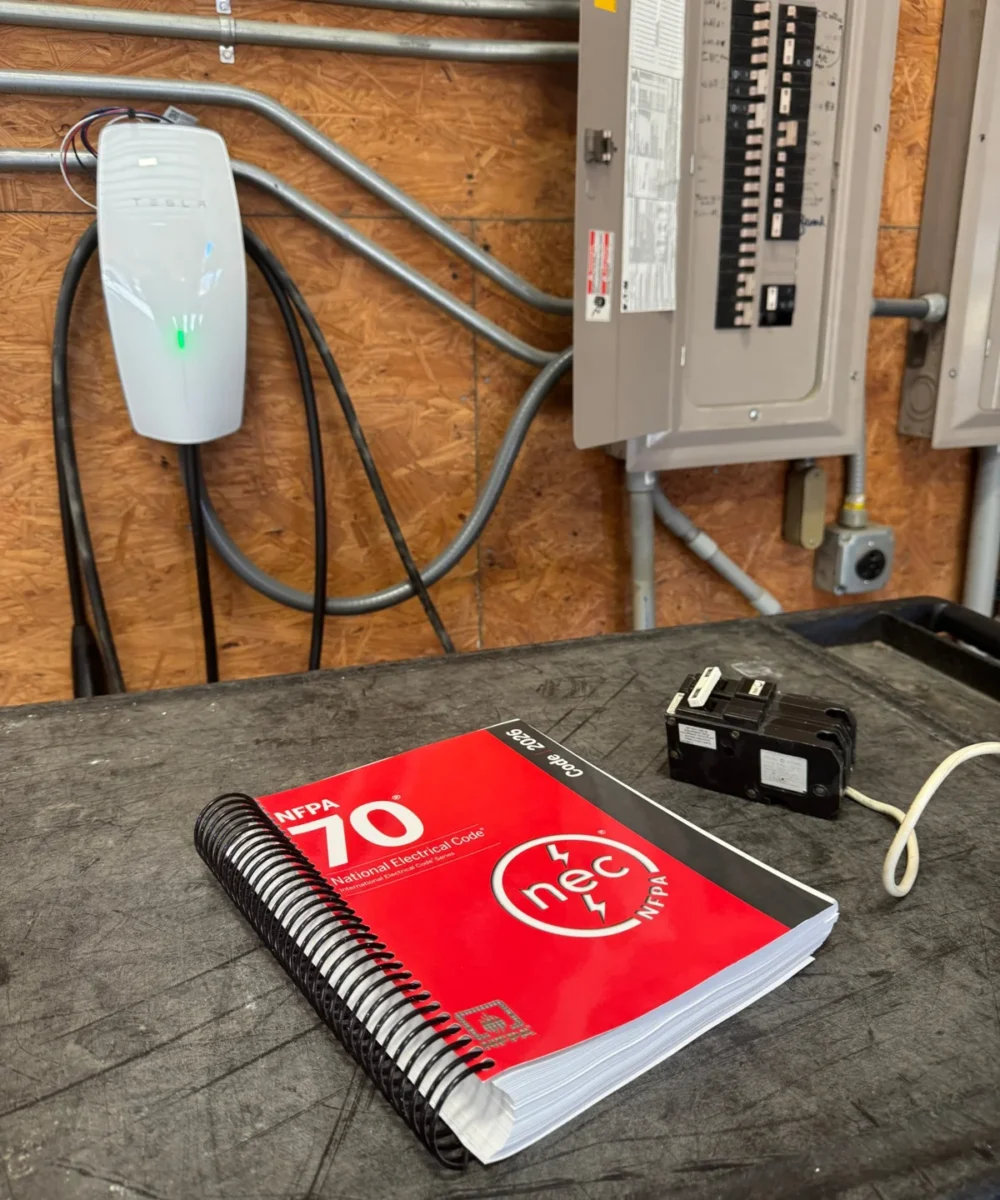
The rule changed on September 1, 2026, and it turns on where the charger is mounted. A hardwired charger outdoors at a Texas home now needs GFCI protection on a circuit of 60 amps or less. That includes the standard setup, a 48-amp charger on a 60-amp breaker, which used to sit just outside the rule.
The short answer
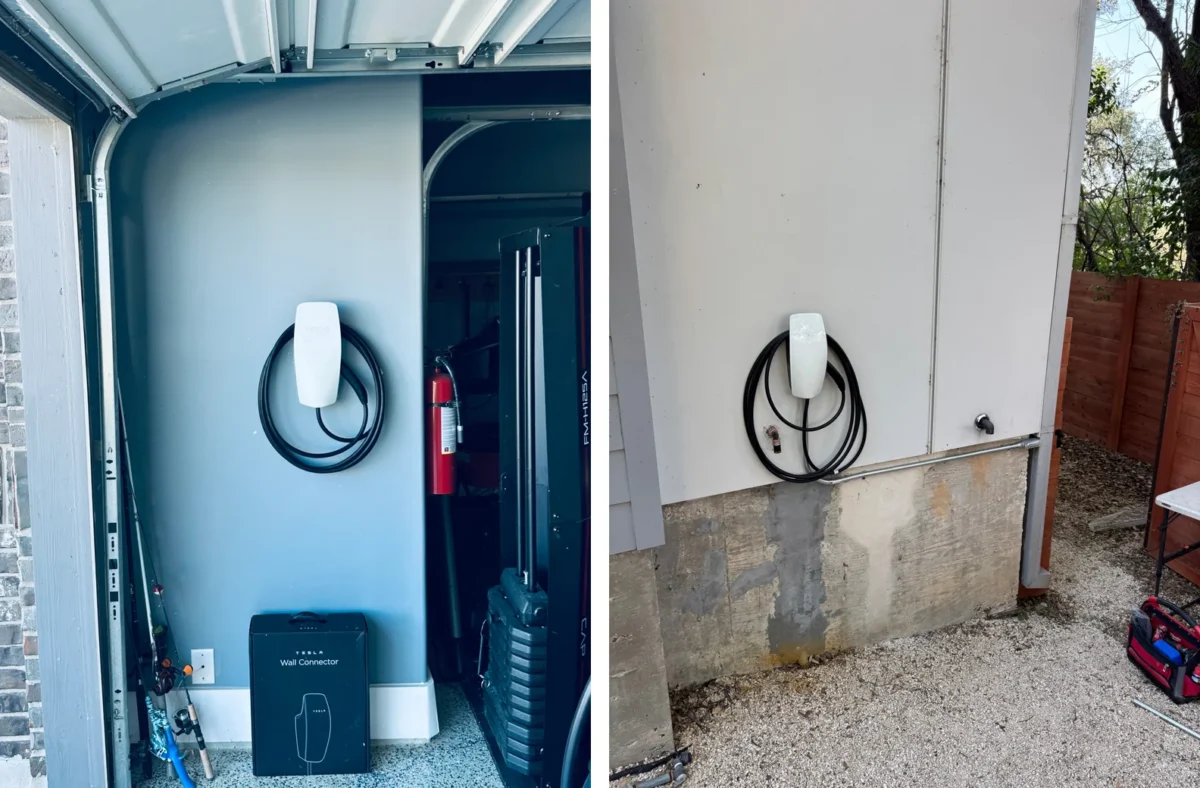
- Outdoors, hardwired, 60A or smaller: GFCI required. This is new for 60A circuits.
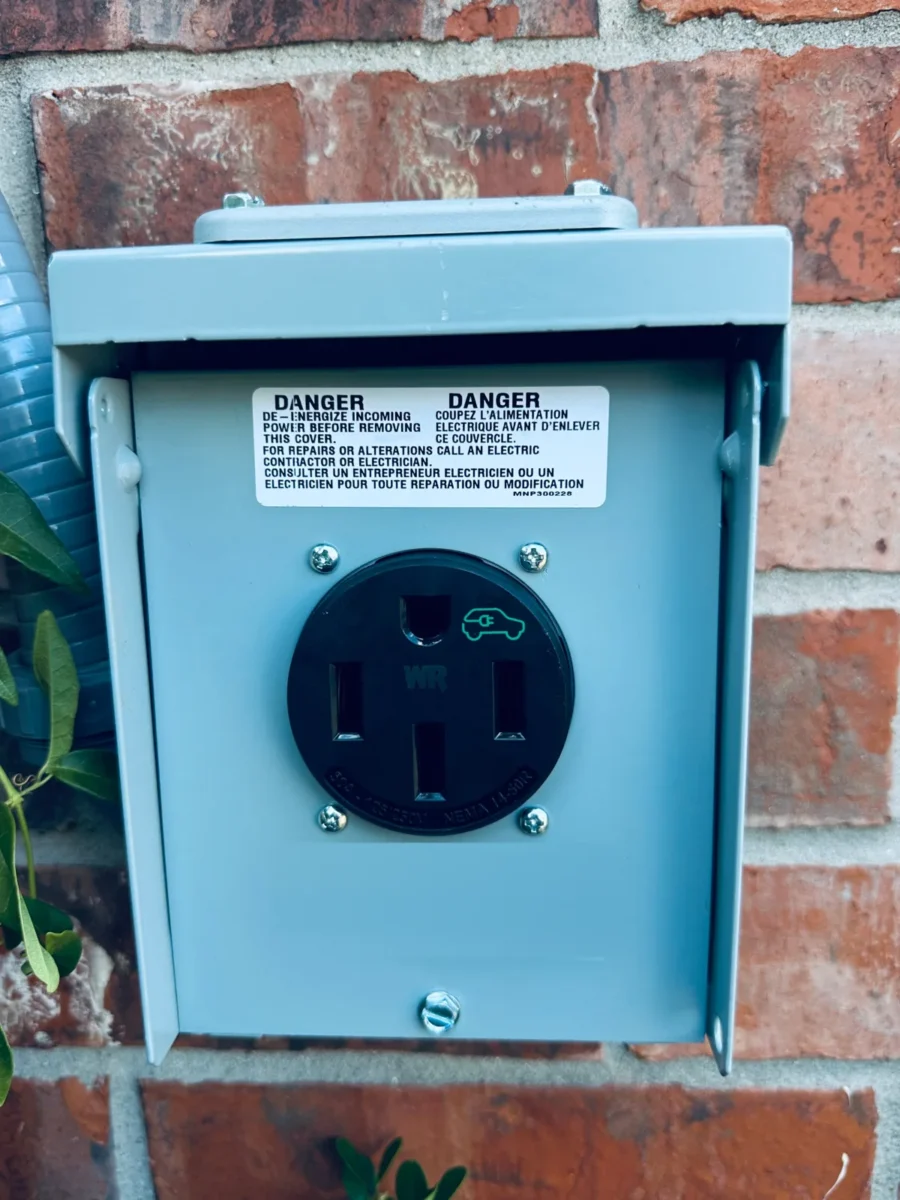
- Plug-in charger (NEMA 14-50, 6-50, and similar), garage or outdoors: GFCI required. This has been the rule for years.
- Hardwired inside an enclosed garage: no GFCI required by either rule.
- Hardwired outdoors on a circuit larger than 60A, such as an 80A charger on a 100A circuit: not covered by the outdoor rule.
The new rule applies to permits applied for on or after September 1, 2026. A charger that was installed and inspected before that date does not have to be updated.
What changed on September 1, 2026
Texas adopted the 2026 National Electrical Code statewide on September 1, 2026. It is the minimum standard for non-exempt electrical work in cities and in unincorporated areas.
The section that matters is NEC 210.8(F), Outdoor Outlets. It requires GFCI protection for outdoor outlets at dwellings on single-phase circuits of 150 volts or less to ground. The 2023 code capped that at 50 amps. The 2026 code raised it to 60 amps.
That 10-amp change is the whole story for most home chargers. Forty-eight amps is the common high-output setting, because it is the most that most Teslas and many other EVs will accept. EV charging is a continuous load, so the code sizes the branch circuit at 125 percent: 48 × 1.25 = 60. The ordinary install is a 48A charger on a 60A breaker. Under the old 50A cap, that was just outside the rule. Under the new 60A cap, it is inside it.
An outlet in the code is not just a receptacle. It is any point where current is taken from the wiring to supply equipment, so a hardwired charger counts.
Texas adopted the 2026 code with one change to this section. Listed outdoor air-conditioning equipment keeps an exemption from 210.8(F), and Texas removed the expiration date that NFPA put on that exception. There is no exemption for EV chargers.
What did not change
Plug-in chargers still need GFCI everywhere. NEC 625.54 requires GFCI protection on any receptacle installed for EV charging, indoors or outdoors. A NEMA 14-50 for a portable charger has needed a GFCI breaker for several code cycles.
Hardwired chargers indoors are still exempt. The garage rules in 210.8(A) cover receptacles only. A charger wired directly into a circuit inside an enclosed garage is not a receptacle, so neither 210.8(A) nor 625.54 applies to it.
That almost changed. An early draft of the 2026 code would have required GFCI protection on every hardwired charger, indoors and out. Automakers and charger manufacturers appealed. Their argument was that listed chargers already carry certified shock protection, and that stacking a Class A GFCI breaker on top causes nuisance trips. In August 2025 the NFPA Standards Council agreed and kept that expansion out of the published code.
Garage, driveway, or plug-in
| Install | Circuit | GFCI required? | Code section |
|---|---|---|---|
| Hardwired, outdoors (driveway, exterior wall) | 60A or less | Yes. New for 60A circuits | 210.8(F) |
| Hardwired, outdoors | Over 60A | No | 210.8(F) caps at 60A |
| Hardwired, inside an enclosed garage | Any size | No | Neither rule applies |
| Plug-in (NEMA 14-50, 6-50), garage or outdoors | Any size | Yes. Unchanged | 625.54 |
A carport or an open-sided garage is a judgment call. If the charger sits where weather can reach it, expect the inspector to treat it as outdoors.
What a GFCI breaker does, and why it trips on EV chargers.
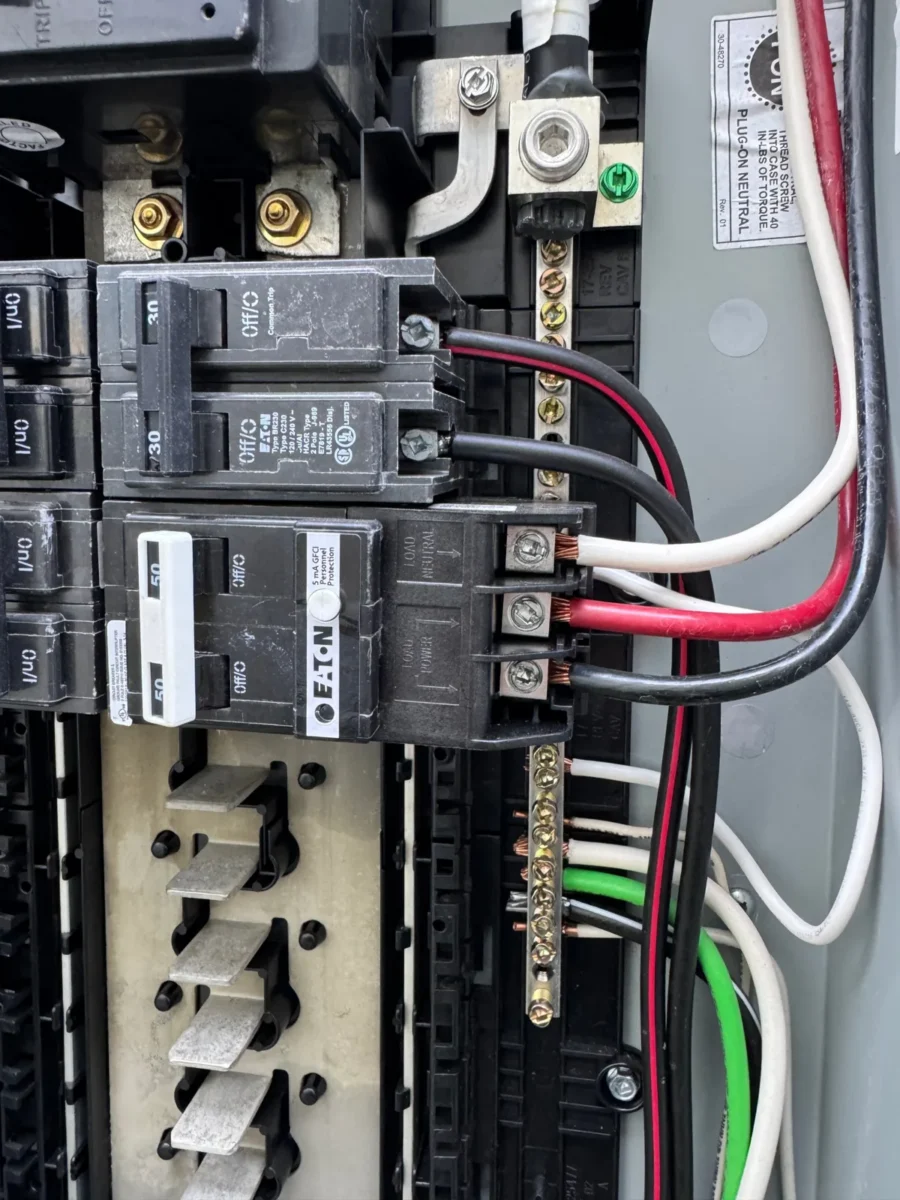
A standard breaker trips on overloads and short circuits. It protects the wiring from overheating. A GFCI breaker also watches for current leaking off the circuit, from a nicked wire, water in a box, or a faulty charger. At about 5 milliamps it opens in a fraction of a second, before a shock can do serious harm.
That sensitivity is why nuisance tripping is a real problem, and it is the main reason the industry fought the wider rule. A car’s onboard charger produces small amounts of electrical noise and leakage while it charges. A 5-milliamp device can read that as a fault and trip, even though nothing is wrong. You find out the next morning, when the car has not charged.
Newer GFCIs marked HF are built to tolerate the high-frequency leakage that electronics produce. The 2026 code recognizes them, and they should help. They are still scarce, especially in the 60A two-pole size, so most outdoor installs today get a standard Class A GFCI.
What this means for the install
An outdoor charger on a 60A or smaller circuit now costs more, and it can leave you with an uncharged car.
The cost is the breaker. A 60A two-pole GFCI costs several times a standard breaker. On some older panels one is not made at all, which means a separate GFCI disconnect or a small subpanel.
The risk is the trip. You plug in at night and wake up to a dead breaker. Until HF-rated devices are easy to get in this size, most outdoor installs will use a standard Class A GFCI, which is the one more likely to trip.
Three ways to keep both in check:
- Mount it in the garage if the cable will reach. A hardwired charger inside an enclosed garage needs no GFCI, so there is no extra breaker and nothing new to trip.
- Put a GFCI disconnect next to the charger. It costs a bit more than a breaker in the panel, but a trip can be reset in the driveway instead of at the panel.
- Ask for an HF-rated GFCI. It costs more and isn’t made for every panel yet, but where one is available it’s worth paying for. It’s built to ride through the electrical noise that trips a standard Class A GFCI.
FAQ
I already have a charger. Do I need to change it?
No. A charger permitted and inspected before September 1, 2026 does not have to be updated, even if it is outdoors on a standard breaker. The new rule applies to new work: moving the charger, adding or changing its circuit, or upgrading the panel it runs from. If you are planning any of that and the charger is outdoors, plan on a GFCI.
Tesla’s manual says not to use a GFCI breaker. Which is right?
The code. Tesla’s Gen 3 Wall Connector manual tells installers not to add a GFCI breaker, and Emporia gives similar advice, because the charger has its own ground-fault protection. A manufacturer’s instructions govern how the equipment is installed. They do not waive a code rule that applies to the outlet. Outdoors on a 60A or smaller circuit, the GFCI is required whatever the manual says. Mention it to the inspector up front so it does not become a failed inspection.
My charger already has ground-fault protection. Why isn’t that enough?
The code does not count it as a GFCI. Level 2 chargers carry a built-in device certified under UL 2231, often called CCID20, that trips at about 20 milliamps. A code-defined Class A GFCI trips at about 5 milliamps. A less sensitive device does not satisfy a rule that calls for a GFCI. On outdoor charger circuits, inspectors are asking to see a Class A device by name.
My charger doesn’t use a neutral. Can a GFCI breaker even work?
Yes. A two-pole GFCI breaker compares the current on the two hot legs and trips if they do not match. Its white pigtail lands on the panel neutral bar to power the breaker’s electronics. No neutral runs to the charger. The charger is still two hots and a ground.
Does a NEMA 14-50 for an EV need a GFCI?
Yes, in a garage or outdoors. The 2026 code also requires 30A, 50A, and 60A receptacles used for EV charging to be listed for that use, because a standard receptacle can overheat under hours of continuous load. That is one more reason to hardwire.
Sources
- TDLR: Commission adopts the 2026 NEC
- Texas Register: TDLR rule text and HVAC exception
- Houston Permitting Center: 2026 NEC effective September 1, 2026
- City of Denison: 2026 NEC significant changes
- UL Code Authority: 2026 NEC 210.8(F) outdoor outlets
- CharIN: appeal on 2026 NEC 625.54
- Tesla Gen 3 Wall Connector installation manual
- Emporia: GFCI breaker installation