
Frequently asked questions
Straight answers before your install
Price, permits, panels, wiring, charging speed, and commercial and fast charging. These are the questions we get asked most, answered the way we’d answer them standing in your garage.
Updated October 2026
- Licensed · TECL #37972
- Our own electricians, never subcontracted
- We pull the permit and guarantee the inspection
- Same-day quotes from photos
No questions match that. Email us at info@chargeprotexas.com and we’ll answer it, usually the same day.
Before you book
Why does an install cost what it does?
Almost all of it is distance. Every foot between your panel and where you park is copper wire, conduit and labor, so a charger on the wall next to a garage panel costs a fraction of one that has to cross the attic or go out to a detached garage.
Typical installs run about $800 when the panel is within 10 feet, around $1,300 for 10 to 50 feet, and $2,000 and up for longer runs, second stories or trenching. Those numbers don’t include the charger itself, permits, panel upgrades or load management. You can get a rough range from our install cost estimator.
Beyond the distance, you’re paying for licensed electricians on our own payroll and quality materials throughout, chosen so your install keeps working long after the warranty runs out. We’re all about high-quality installs, and we’d rather do it right once than cut corners to lower the price.
Can you quote an EV charger install without coming out?
Most of the time, yes. Quoting from photos is free, and we usually send a real price the same day. To get there, we need a few things from you:
Three photos: your electrical panel with the door open, close enough to read the breakers and the label inside the door; the wall where you want the charger; and the path between the two, including the outside of the house or the attic access if the route goes that way.
Your charger: tell us if you already have one, and which brand and model, or if you’d like us to supply it. If you haven’t picked one yet, we’ll recommend the right charger for your car and your panel.
Your car: the year, make and model, and whether a second EV is likely in the next few years. That decides the plug type and how fast your car can charge, and it lets us plan for two cars now instead of rewiring later.
Anything else that helps: where you park and which side your charge port is on, whether the charger goes inside the garage or outside, if you have solar, a home battery (like Base) or a generator, if you’re in an HOA, and if the job is urgent. Mention any other electrical work you want done too, and we’ll quote it together.
Some houses are genuinely complicated, like a detached garage, a long trench or an older panel. For those we’ll ask a few more questions or ask to walk the job in person. A site visit is $250, credited back against your install if you go ahead with us.
Is there a rebate or tax credit?
There’s no federal tax credit anymore. The 30C credit for charging equipment expired June 30, 2026, for homes and businesses alike.
Utility programs depend on who delivers your power. Austin Energy currently offers a rebate of 50% of a compatible home charger’s price, up to $500, when you enroll in its Power Partner EV program, which lets it briefly slow your charging during peak summer demand. CenterPoint (Houston) and Oncor (Dallas–Fort Worth) don’t offer a cash rebate for home charger installs.
We install across many other utilities too, including electric co-ops and city-owned utilities, and some run their own programs: a small rebate, a bill credit, or a rate plan with cheap or free overnight charging. Programs change often, so when we quote we’ll check what your utility offers and point you to it.
Do I need a permit?
In most places, yes. A Level 2 charger means a new 240-volt circuit, and most cities and counties require an electrical permit for that, including Austin, Houston and Dallas–Fort Worth. Some areas, often outside city limits, don’t. We’ll tell you which applies to your address when we quote.
Where a permit is required, we pull it, schedule the inspection and meet the inspector. And we guarantee it passes: if the inspector flags anything, we come back and put it right at our cost.
How long does the install take, and when can you do it?
Most installs take a few hours. Long runs, trenching or panel work can stretch to a full day, and we’ll tell you what to expect when we quote.
Once you accept the quote it’s purely a scheduling question. If it’s urgent, tell us and we’ll try to find a gap in the schedule. We don’t promise a date we can’t hold. The permit and inspection run alongside the install, and the inspector comes on a separate visit.
What happens on install day?
Our electricians arrive, walk the route with you, and confirm where the charger goes. Most installs take a few hours. The power is only off for a short time while we connect the new circuit at your panel, and we’ll tell you before we switch anything off.
To help us move fast: clear a few feet in front of your panel and along the route, have your Wi-Fi password ready so we can connect the charger, and if you can, have the car home so we can test a real charge before we leave. We clean up when we’re done. The city inspection is a separate visit, and we coordinate it with you.
Do I need to be home for the install?
Not necessarily you, but someone has to let us in. Depending on the route we may need the garage, the panel, the attic and sometimes the backyard, so whoever’s there should be able to open all of it. The inspector needs access on a separate visit too, and we’ll coordinate both with you.
What’s covered if something goes wrong?
A one-year workmanship warranty, with extended coverage available. Your charger carries its own manufacturer warranty on top of that, usually around four years. Our own electricians do every install, so the company you call is the company responsible for the work.
Can I install a charger myself?
We don’t recommend it. A Level 2 charger is a new 240-volt circuit carrying a heavy load for hours, and mistakes in sizing or connections are a real fire risk. Most cities require a permit and inspection for the work, and most charger warranties and utility rebates expect a licensed electrician and a permitted install. Doing it right the first time is cheaper than fixing it after a failed inspection or an insurance claim.
Can you do other electrical work while you’re here?
Yes. Mention it when you request a quote and we’ll price it together, so it’s one visit. Besides installing EV chargers, we service and repair them, and we install panel upgrades and replacements, SPAN smart panels, load management systems, home battery backup, standby generators and vehicle-to-home (V2H) backup systems.
Choosing a charger
Do I need a Level 2 charger, or is a regular outlet enough?
A regular 120-volt outlet (Level 1) adds only about 3 to 5 miles of range per hour. That can work for a short commute, but after a long day or a road trip it can take more than a day to catch up. A Level 2 charger on a 48-amp circuit is roughly ten times faster and refills a typical day of driving in about an hour.
See the difference for your own car with our EV charging time calculator.
Which charger should I get?
We recommend two chargers, and they’re the ones we install most: the Tesla Universal Wall Connector (or the Tesla Wall Connector if you only drive Teslas) and the Emporia charger. Both are top of the line, both charge at the full 48 amps, and both come with an app for scheduling and tracking your charging.
The Tesla Universal Wall Connector has both plug types built in, Tesla’s NACS and the J1772 most other EVs use, so it works with any EV, including a mixed household or whatever you drive next. It’s also our pick when your panel needs load management: paired with a Neurio energy meter, it slows down automatically when the house is busy. Emporia is a great choice for full-speed charging straight from your main panel, and comes in a J1772 or a NACS version.
Many car makers also sell their own chargers, and we’ve installed all of them. Most work the same way, so we’re confident installing any charger. Already bought one? We’ll install it. Haven’t? Tell us what you drive and we’ll tell you what we’d put on our own house.
I already bought a charger. Will you install it?
Yes. We install every major brand, including chargers sold by the car makers. Your charger keeps its manufacturer warranty, and our workmanship warranty covers the installation. If you haven’t bought one yet, ask us first: we’ll make sure it fits your car and your panel.
My car has a Tesla-style (NACS) port. Which charger fits, and are adapters safe?
Most car makers are switching from the J1772 plug to Tesla’s NACS plug, so many newer EVs now come with a NACS port, while plenty of J1772 cars remain on the road. The easiest answer is a charger that has both plugs built in, like the Tesla Universal Wall Connector, so you don’t need an adapter at home at all.
If you do use an adapter, use the one your car maker supplies or approves. Some makers warn that third-party adapters can affect warranty claims on the charge port.
Hardwired charger, or a NEMA 14-50 outlet?
Hardwired, almost always. It’s safer, it charges faster, and if you move we can take it off the wall and reinstall it at the new house.
The outlet sounds cheaper and usually isn’t. It needs an extra neutral conductor, a GFCI breaker that’s expensive and nuisance-trips, and an EV-rated receptacle, because cheaper ones are known to burn up under charging loads. Each of those adds cost, and it still caps you at 40 amps.
Renting? Hardwired still works, since the charger comes with you when you leave. You’ll need your landlord’s OK before we can pull the permit, and we’re happy to answer their questions by email.
Can I use my dryer outlet?
No, and we won’t install a charger that way. A dryer outlet and its wiring were never designed for an EV. A dryer cycles on and off for an hour or so, but a car pulls full power continuously for hours. That sustained load overheats outlets, plugs and connections that weren’t built for it, and it’s a real fire hazard, whether you use an adapter, an extension cord or a splitter.
That’s exactly why a proper charger circuit is built differently: heavy-gauge wire sized for continuous load, and either a hardwired connection or an EV-rated outlet made to carry full power for hours. If you’re worried your panel can’t take another circuit, we’ll check it, and load management usually solves it without a panel upgrade.
What if I want to add a second charger?
In most cases each charger needs its own dedicated circuit, so a second charger means a second circuit run from your panel, and enough capacity in the panel to carry both. We’ll check that with the load calculation.
The exception is chargers that can share power. Tesla Wall Connectors can talk to each other and split one circuit between two cars, giving each car full speed when it charges alone and sharing automatically when both are plugged in. That often means one circuit instead of two, which can save the cost of a second run or a panel upgrade.
If a second EV is likely in the next few years, tell us now. Planning both at once usually costs less than coming back later.
Will the cable reach my car? Can I use an extension cord?
Never use an extension cord with an EV. Car makers prohibit it, and an ordinary cord can overheat under hours of full power.
Instead, we plan the charger’s location around where you park and where your car’s charge port is. Most wall chargers come with a cable of about 18 to 25 feet. Tesla’s Wall Connectors have a 24-foot cable. If you have two cars or switch sides of the garage, tell us, and we’ll mount it where the cable reaches both.
Your panel and wiring
Do I need a panel upgrade?
Probably not. Most homes can take a Level 2 charger on the panel they already have. When a panel looks tight or dated, we run a load calculation for free.
If the numbers come up short, the usual answer is load management. We recommend Tesla’s Universal Wall Connector with a Neurio energy meter, which slows the charger whenever the house is using a lot of power. That costs a few hundred dollars instead of a few thousand for a service upgrade.
An upgrade is the right call when the panel is too old, in bad condition, or simply too small for the house. Federal Pacific Stab-Lok and Zinsco panels, for example, have a documented history of breakers that don’t trip when they should, so we won’t put a charger on one. If that’s your situation, we’ll show you in your own photos and price the replacement honestly.
What’s a load calculation, and do I need one?
It confirms your electrical service can carry a charger on top of everything else in the house. Rather than estimating, we use your real usage: we ask you for your electricity data from your utility in 15-minute intervals for the last 12 months. That shows your true peak, usually a hot summer afternoon, and exactly how much room is left for a charger.
Most Texas utilities let you download this from your online account, and we’ll tell you where to find it. The calculation is free. A charger is a continuous load, so the circuit is sized at 125%: a 48-amp charger needs a 60-amp breaker.
Why does an EV charger need its own circuit?
Because it’s a continuous load. A charger pulls close to its full power for hours at a time, which almost nothing else in a home does. A circuit shared with other outlets or appliances would be overloaded every time both ran at once, and the wiring and connections would run hot.
That’s why electrical code requires every EV charger to have its own dedicated circuit with nothing else on it, sized at 125% of the charger’s load. A 48-amp charger gets a 60-amp breaker and wire rated for it. The only exception is chargers designed to share power with each other on one circuit, like Tesla’s Wall Connectors.
Can I use my subpanel?
Sometimes. A subpanel can only supply what the wire feeding it allows. A garage subpanel fed at 60 amps can’t carry a 48-amp charger on top of everything else already on it.
We go from the main panel wherever we can. When feeding from a subpanel is the right call, we always add load management (typically Tesla’s Universal Wall Connector with a Neurio energy meter) so the charger can’t overload it.
How do you get from my main panel to my garage?
Most of the time we run conduit one of two ways: up into the attic, across, and back down on the other side, or along the wall, either on the outside of the house or inside or outside the garage.
House size matters too. A two-story attic run is more work than a single-story one, and every extra foot is wire, conduit and labor. That’s why we ask for a photo of the path, not just the two ends.
Here’s what those routes look like when our crews are done:
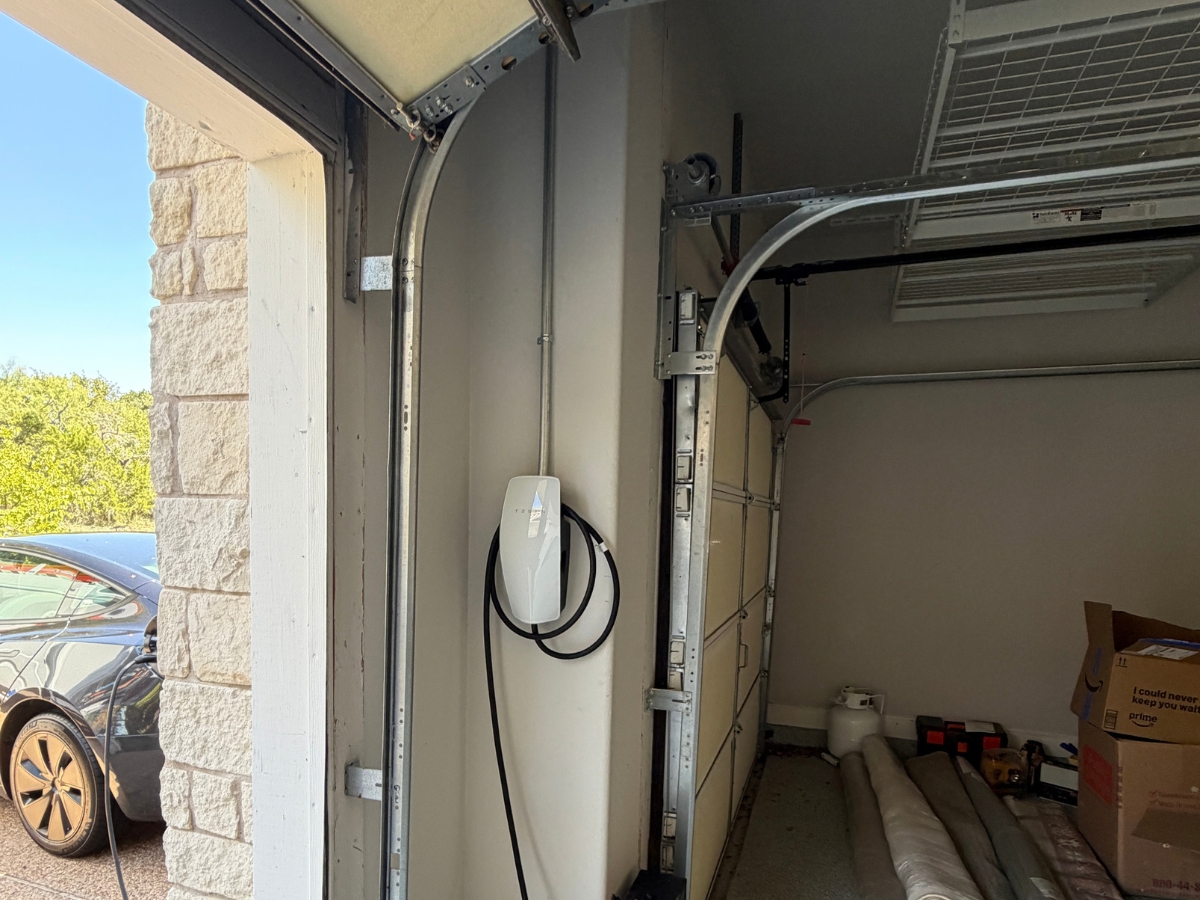
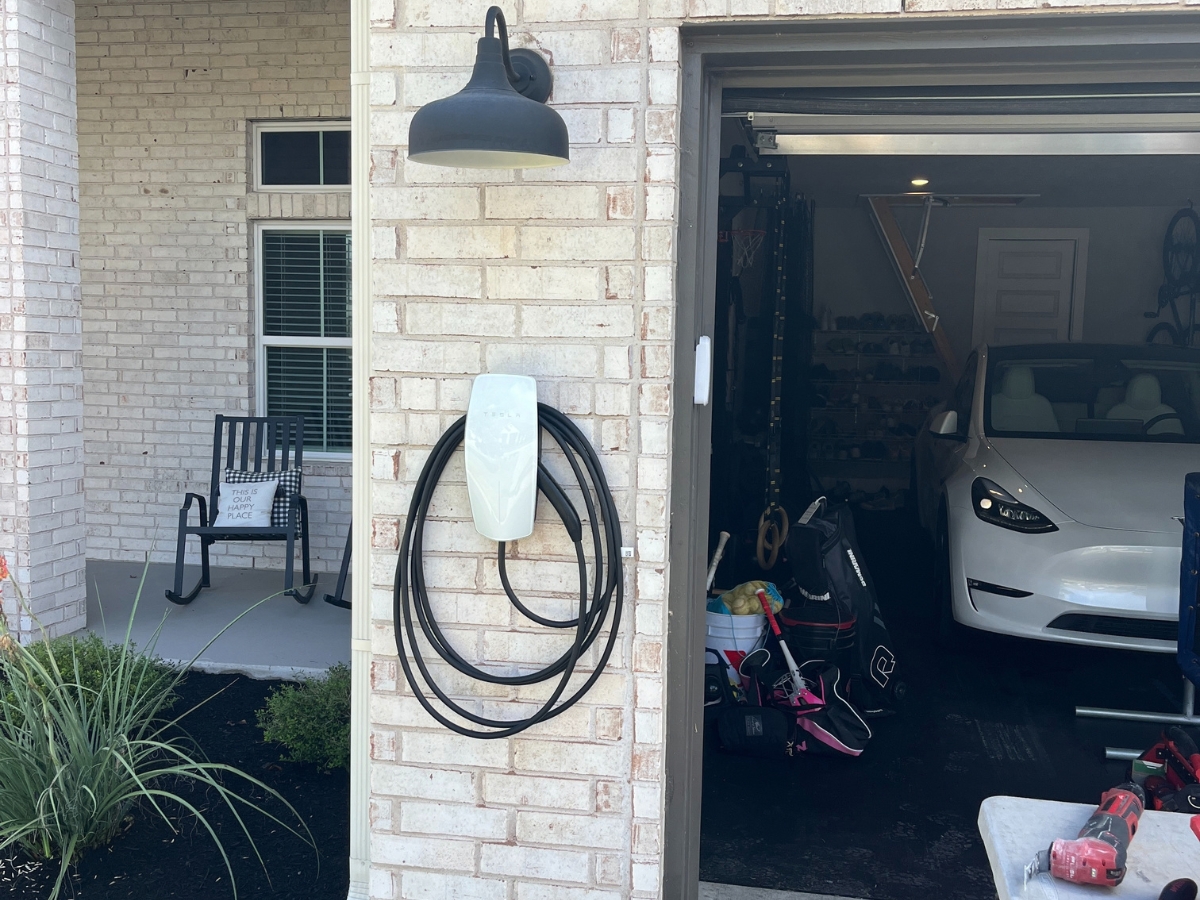
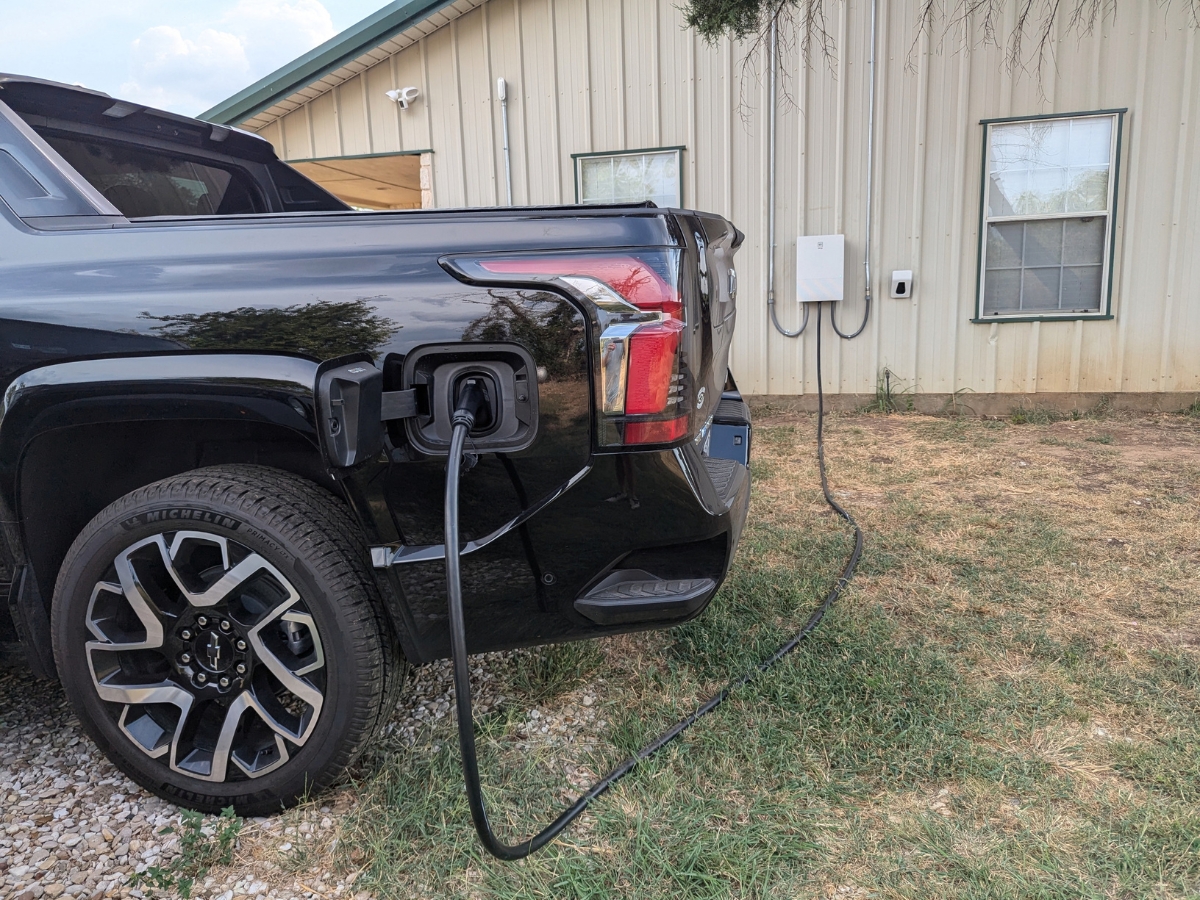
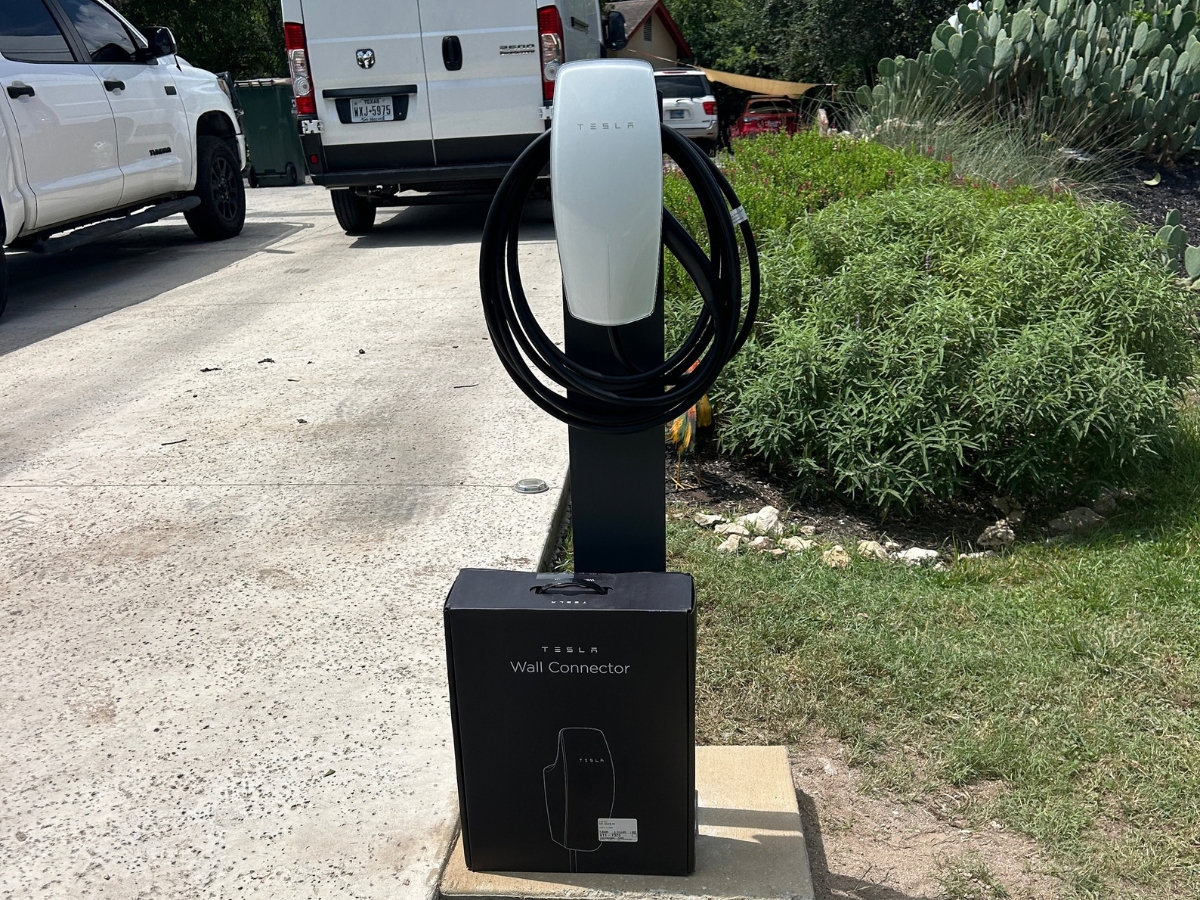
Every run uses weatherproof conduit, installed straight and square, with every wall penetration sealed.
Can you hide the conduit inside the wall?
Yes, when the wall is accessible. If there’s an open path, like an unfinished garage wall or a straight drop from the attic, we can run it inside the wall and all you’ll see is the charger.
If it would mean cutting sheetrock, we usually don’t recommend it. Cutting, patching and finishing drywall takes extra labor and adds significantly to the price. A neat, paintable conduit run gets you most of the way there for much less.
What is a whole-home surge protector, and do I need one?
A whole-home surge protector is installed at your electrical panel and protects every circuit in the house from voltage spikes. Spikes come from nearby lightning, utility switching, storms, and the grid coming back on after an outage, which is common in Texas. Plug-in surge strips only protect what’s plugged into them; a whole-home protector stops the surge where it enters the house.
It’s worth it for any home with expensive electronics, and especially with an EV charger, a home battery, solar or a smart panel, all of which are full of sensitive electronics. It’s a small cost next to replacing a charger, an AC control board or a fridge. Current electrical code requires one on every new home, and on any existing home whenever its electrical service is replaced or upgraded, so it’s part of every panel upgrade we do. If your home was built before that rule, you likely don’t have one, and we can add one to your existing panel.
A surge protector can’t stop a direct lightning strike to your house, but it handles the far more common everyday surges. For the best protection, pair it with plug-in surge strips on your TV and computer.
Outdoor installs
Can you install outside on a pedestal?
Yes. When there’s no wall where the car parks, we mount the charger on a pedestal set on a poured pad. If the wire has to get there underground, trenching is part of the price.
Weatherproof conduit is our standard on every install, so outdoors isn’t a compromise. Outdoor chargers now also need GFCI protection (see below), and we include it in the quote.
Does an outdoor charger need GFCI protection?
Yes. Under the newer electrical code being adopted around Texas, inspectors now require GFCI protection on chargers installed outdoors, whether on an outside wall, a carport or a pedestal. A GFCI breaker cuts the power within a fraction of a second if it detects current leaking where it shouldn’t, such as through water or a damaged cable. That matters more outside, where the charger and cable are exposed to rain.
It means a GFCI breaker at your panel in place of a standard one, which costs more, so it’s part of the price for any outdoor install. Chargers inside a garage were nearly added to the same rule, but they’re still exempt, so an indoor garage install doesn’t need GFCI protection for now. Rules can vary by city, so we follow whatever your local inspector requires and include it in your quote up front.
Is a charger safe in Texas heat and rain?
Yes. The chargers we install work fine in Texas heat and rain. They’re UL listed (safety-tested to the U.S. standard for EV chargers), have weather-resistant enclosures for outdoor use, and are rated to run in temperatures up to about 122°F.
For outdoor installs, we still recommend shade where you can get it, like under an eave, a carport or on the north or east side of the house. Where there’s no natural shade, a charger cover or small shade hood mounted on the wall above the charger does the job, and we can install one with your charger. A cover isn’t required, and your charger will work fine without one, but it doesn’t hurt and can help on the hottest days. Keeping the charger out of direct afternoon sun helps prevent overheating, so it’s less likely to slow down charging on the hottest days, and it’s easier on the charger and cable over the years.
Our part is the installation: a dedicated circuit sized for the load, weatherproof conduit, sealed connections, and GFCI protection on outdoor installs.
Charging at home
How long does it take to charge?
On a 48-amp charger, most EVs add roughly 25 to 45 miles of range per hour, depending on how much power the car itself can accept. Plugged in overnight, nearly every car is full by morning. A regular wall outlet adds about 3 to 5 miles per hour.
Speed is set by the breaker: a 60-amp breaker allows 48 amps of charging, a 50-amp breaker 40, and a 40-amp breaker 32. We install 48 amps wherever your panel allows, and run heavy-duty wire on every circuit so the next car is covered too. If you have load management, the charger slows briefly when the house is busy and comes back up on its own.
Want numbers for your car? Try our EV charging time calculator.
How much does it cost to charge at home compared with gas?
Usually far less. At 15 cents per kWh, a typical EV costs around 4 to 5 cents a mile to charge at home. A gas car that gets 25 mpg costs about 12 cents a mile at $3 a gallon. Over a year of normal driving that’s often well over $1,000 saved, before counting the lower maintenance.
Your exact number depends on your electricity plan, your car and how much you drive. Plans with cheap or free overnight electricity make home charging even cheaper. Run your numbers with our Texas EV savings calculator.
Should I charge to 100% every night?
Usually not. Most EV owners set their car’s charge limit to 80% for everyday driving. Keeping a lithium-ion battery full all the time wears it faster, so stopping at 80% helps the battery last. Charge to 100% when you need the range, like the night before a road trip.
There’s one exception: some cars use LFP batteries, including some standard-range Teslas, and their makers recommend charging to 100% regularly. Your car’s app or manual will say which applies. Either way, you set the limit in the car or its app, not on the charger.
How does Texas heat affect charging and batteries?
Charging speed. Chargers and cars protect themselves from heat. On a very hot afternoon, a charger sitting in direct sun or a car with a hot battery may slow charging down until things cool off. That’s one more reason to charge overnight, when it’s cooler and electricity is often cheaper, and to give an outdoor charger some shade.
Your car’s battery. Heat is the main thing that ages an EV battery over time. Parking in a garage or shade helps, and so does the 80% everyday charge limit, since sitting at a full charge in high heat is harder on a battery. Leaving the car plugged in on hot days also helps: many EVs use power from the charger, not the battery, to keep the battery cool.
Fast charging. A battery that’s already hot charges slower at a fast charger. If your car can precondition the battery on the way to a fast charger, use it, and expect slower sessions on the hottest days.
Home and backup batteries. Home batteries also slow down or limit output in extreme heat to protect themselves, and they need the clearance and airflow their maker requires. We place equipment to follow those rules, out of direct sun where possible.
Cold snaps. Texas freezes matter too. Cold slows charging and cuts range for a while. Keep the car plugged in during a freeze and warm it up (precondition) while it’s still on the charger, so the energy comes from the wall instead of your battery.
Does my charger need Wi-Fi?
Yes, plan on it. Most chargers need a Wi-Fi connection to be set up and to work the way they should. The app is how the charger gets its settings and software updates, and how you schedule charging, track your use and take part in utility programs like Austin Energy’s Power Partner EV. Without Wi-Fi, many chargers won’t finish setup or will run only in a limited mode.
Garages often have weak Wi-Fi, so check the signal where the charger will go before install day. If it’s poor, a mesh Wi-Fi point or extender near the garage usually fixes it. Tesla’s Wall Connectors connect on 2.4 GHz Wi-Fi. Have your Wi-Fi name and password ready on install day so we can connect the charger and test it before we leave.
My charger won’t connect to Wi-Fi. What’s the deal with 2.4 GHz and 5 GHz?
Most EV chargers only connect to 2.4 GHz Wi-Fi. That band reaches farther and gets through walls better than 5 GHz, which matters in a garage. The problem is that many newer routers combine 2.4 GHz and 5 GHz under one network name and switch devices between them automatically. Phones handle that fine, but a charger often can’t find or hold the connection.
Create a guest network. Most routers and internet-provider apps let you add a guest network in a few taps. Set it to 2.4 GHz only and connect the charger to it. It also keeps the charger separate from your personal devices.
Split the bands. In your router settings, turn off the combined network option (often called smart connect or band steering) or give the 2.4 GHz band its own name, then connect the charger to that one.
Add an extender or mesh point. If the signal in the garage is weak, a Wi-Fi extender or mesh point near the garage fixes the range. Make sure it broadcasts on 2.4 GHz.
A few more things that trip chargers up: networks that use WPA3 security only (choose WPA2/WPA3 mixed mode instead), and networks with a sign-in page, like some apartment or HOA Wi-Fi. If you’re not sure how to change your settings, your internet provider can usually walk you through it, and we’ll help get the charger connected on install day.
Owning a charger
Do you service and repair EV chargers?
Yes. We troubleshoot, repair and maintain EV chargers, from home chargers to commercial Level 2 stations and DC fast chargers, including chargers someone else installed. Common problems are chargers that won’t start a session, trip breakers, drop off Wi-Fi or the network, or charge slower than they should.
For businesses, we also offer ongoing maintenance to keep stations up and running, because a broken charger costs you customers and, for public chargers, can mean taking it out of service. If a charger is still under the manufacturer’s warranty, we’ll help you work through that process too.
Can I take my charger with me when I move?
Yes. A hardwired charger comes off the wall with a few screws. We disconnect it and safely cap the circuit, and the charger moves with you. At your new home we install a new circuit for it the same way. The circuit and its permit stay with the house you sold, which buyers with EVs tend to like.
Will a home charger add value to my home?
There’s no proven dollar figure, so we won’t promise one. But more buyers drive EVs every year, and a permitted, inspected 240-volt charging circuit in the garage is a feature they notice. Keep the permit and inspection record. Buyers and their inspectors may ask for it.
Do I need to tell my home insurance company?
It’s a good idea. A hardwired charger can count as part of your home, so let your insurer know and ask whether it’s covered for things like surge damage or theft. A permitted, inspected install also helps if you ever need to make a claim, which is one more reason not to skip the permit.
I live in an HOA, condo or rental. Can I get a charger?
Usually, with permission. HOAs can have rules about anything visible from outside, like exterior conduit or a pedestal, so check your community’s rules and get approval before we start. In a condo or apartment, the building’s electrical system usually belongs to the association or owner, so they have to sign off.
Renters need the landlord’s written OK because the permit is pulled for their property. We’re happy to answer an HOA’s, property manager’s or landlord’s questions by email at info@chargeprotexas.com.
Do I need to tell my utility about my charger?
For a single home charger, usually not. If your home’s usage grows a lot, for example with two EVs or a large service upgrade, the utility may check whether the transformer serving your street needs upgrading. If a service upgrade is part of your job, we coordinate with the utility for you.
Backup power, solar & V2H
Battery or generator: which is better?
It depends on what you need. A standby generator runs for days as long as it has fuel and usually costs less for whole-home backup, but it needs maintenance and it’s loud. A battery is quiet and switches over almost instantly, but costs more for the same coverage. If you already have solar, a battery usually makes the most sense.
We install both, including Generac and Kohler generators, so we’ll recommend whichever fits rather than whichever we sell.
What kinds of home battery backup do you install?
We install several kinds of battery backup, and the right one depends on your home, your budget and how you want to own it:
A battery you buy. A battery system you own outright, often paired with solar so it can recharge itself during a long outage.
A battery program. Some companies, like Base Power, install and maintain a battery at your home as part of a program instead of selling it to you outright. We’re an installer for Base. To see Base’s plans or sign up, start at www.basepowercompany.com/chargepro.
Your EV as the battery. With vehicle-to-home (V2H) systems like GM Energy’s and Tesla’s, a compatible EV powers your home during an outage, with or without a stationary home battery.
We’ll walk you through the options for your home and what each one would back up.
Whole-home or partial backup: what’s the difference?
Whole-home backup connects the battery to your entire main panel, so everything in the house can run during an outage, within the battery’s power limit. Partial backup connects only selected circuits, usually the fridge, lights, Wi-Fi, outlets and sometimes the AC, through a separate backup panel.
Whole-home is simpler to live with, since nothing needs rewiring and you choose what to run in the moment. Partial backup can make a smaller battery last longer, because the big loads simply aren’t connected. Either way, every battery has a limit on how much power it can deliver at once, so running several large appliances together can exceed it.
Do I need solar panels for battery backup?
No. Without solar the battery charges from the grid, so during a long outage you’ll want to watch its charge, since it can’t refill until power returns. With solar, the panels can recharge the battery even while the grid is down.
How long will my power stay on during an outage?
It depends on two things: how much energy your battery stores, measured in kilowatt-hours (kWh), and how much power your home pulls while the grid is down. A battery doesn’t drain at a fixed rate. Run only the essentials and it lasts days; run everything like a normal day and it can be gone in hours.
What uses the most. Small loads barely move the needle. Anything that heats or cools, or charges a car, uses a lot:
| Appliance | Typical power while running |
|---|---|
| LED light bulb | About 10 W |
| Wi-Fi router and modem | About 20 W |
| Ceiling fan | 30 to 75 W |
| TV | About 100 W |
| Refrigerator | About 150 W while the compressor runs |
| Microwave | About 1,200 W, for a few minutes |
| Central AC (3 to 4 ton) | 3,000 to 4,000 W |
| Electric oven or range | 2,000 to 5,000 W |
| Electric water heater | About 4,500 W |
| Electric dryer | About 5,000 W |
| Heat strips or space heaters | 1,500 to 15,000 W |
| Level 2 EV charger | 7,000 to 11,500 W |
Typical figures. Your appliances may differ, so check their labels.
Some examples with a 25 kWh home battery. Essentials only (fridge, lights, Wi-Fi, fans, TV and charging phones) average roughly 400 to 600 W, so the battery can carry them for about two days. Add central AC running half the time and you’re closer to 2,000 W on average, about half a day. One hour on an electric dryer uses about 5 kWh, a fifth of the battery. A big Texas home running everything normally can drain it in a few hours. If you have solar, it can recharge the battery during the day and stretch an outage much further.
How to make it last in summer: set the thermostat to 78 to 80°F instead of turning the AC off, so the house doesn’t heat up and force a long, power-hungry recovery. If a storm is coming, pre-cool the house a few degrees while the grid is still up. Close blinds on the sunny side, run ceiling fans, and keep doors closed. If your AC struggles to start on battery, a soft start kit on the outdoor unit cuts its startup surge. We’ll connect you with our HVAC partner, Belton AC, to install one.
Hold off on during an outage: the electric dryer, oven and stovetop (use the microwave instead), the electric water heater (switch its breaker off if you can), pool pumps, space heaters and hair dryers, and charging your EV unless you really need it. In winter, heat strips and space heaters are the biggest drain, so dress warm, close off unused rooms and keep the thermostat low.
Fine to use: the fridge and freezer (keep the doors shut), lights, fans, Wi-Fi, TVs, phones and laptops, the microwave for short bursts, and a gas furnace or gas water heater, since those use only a little electricity for fans and controls.
We size every backup system around what you want to keep running and how your home uses power, so you know what to expect before the lights go out.
Will a home battery run my whole house during an outage?
A whole-home system backs up everything on your main panel, but every battery has a limit on how much power the house can draw at once, which depends on the battery and how many units you have. Running the AC, oven, dryer and an EV charger at the same time can exceed it.
In an outage, keep the big loads to what you need, and hold off on charging your EV until the grid is back if you can. Your battery’s maker, or Base if you’re a Base member, can tell you the exact limits for your system, and we’re happy to explain them too.
What is a soft start, and do I need one?
When an air conditioner’s compressor starts, it pulls a big burst of current for a split second, often several times what it uses once it’s running. That’s why the lights may dim when the AC kicks on. A home battery or a generator has to handle that burst, and if it’s too big, the AC can fail to start on backup power.
A soft start is a small device installed at the outdoor AC unit that ramps the compressor up gently instead of all at once. It typically cuts that startup surge by more than half. That makes it much easier for a battery or generator to run your AC during an outage, and it’s easier on the compressor and on your lights every day.
You don’t need one for normal grid power. It’s worth adding if you have or are getting battery backup or a generator and want to run central AC on it, especially larger units. Soft starts are installed by an HVAC technician, so we partner with Belton AC for them. Mention it when we plan your backup system and we’ll connect you, so it’s done in time for your install.
Does a charger work with my solar or home battery?
Yes. A charger is another circuit in your panel, and solar doesn’t change how we install it. Charge during the day and you’re using your own power.
With a home battery, like a Tesla Powerwall, Enphase or Base system, the question is whether the charger sits on the backed-up side. Usually it shouldn’t, because an EV can drain a home battery quickly during an outage. We’ll look at your setup and recommend where it goes.
Can I add an EV charger if I have a home battery?
Yes. We install EV chargers in homes with battery systems all the time, including Base, and our electricians know how the two work together. In most cases the battery doesn’t need to be shut down for the work.
Two things to plan around. First, many battery systems are rated for a maximum electrical service size. Base systems, for example, support services up to 200 amps, and going beyond that usually isn’t possible without removing the system. If your panel is tight, load management usually solves it, letting you charge at full speed most of the time without a service upgrade. Second, decide whether the charger should be on the backed-up side. Usually it shouldn’t, so an outage doesn’t drain your home battery into the car. We’ll check your setup and recommend the right arrangement.
What is V2H (vehicle-to-home)?
Vehicle-to-home turns your EV into a backup battery for your house. When the power goes out, the car sends energy back through a two-way (bidirectional) charger to run your home, and the system switches over automatically.
An EV battery holds far more energy than most home batteries, so a charged car can keep the essentials running much longer: the fridge, lights, Wi-Fi, fans, and in many homes the AC. Add solar and a home battery, and the system can recharge itself and run with no grid at all.
It takes more than a charger. The system needs equipment that safely disconnects your home from the grid while the car is powering it, so no power flows back onto the utility lines. That’s why V2H is a full system install, not a simple charger swap.
Do you install the GM Energy and Tesla home energy systems?
Yes. We install the newest systems from both, and we were among the first installers in the country to install them. We’re an official GM Energy V2H Program Partner and Tesla certified.
The GM Energy Home System ties your car, a home battery and solar together. It includes the PowerShift Charger, a two-way charger that charges at up to 19.2 kW and powers your home from the car; the V2H Enablement Kit; and the GM Energy PowerBank home battery, which stores energy from the grid or your solar panels. It works with 2026 and newer GM EVs, including the Chevrolet Silverado EV, Equinox EV and Blazer EV, the GMC Sierra EV and Hummer EV, and Cadillac’s EVs such as the Lyriq and Escalade IQ.
Tesla’s version, Powershare, lets a Cybertruck power your home through a Powerwall 3 and a Tesla Wall Connector, alongside your solar.
If backup power is part of why you’re choosing a car, ask us before you buy. We’ll tell you which vehicles and equipment work together and what your home needs.
What is Base Power, and do you install it?
Base Power provides home battery backup in Texas: a battery system at your home that keeps your power on during outages. It backs up everything on your main electrical panel, switches on automatically when the grid goes down, and works with or without solar.
We’re an installer for Base and have installed Base systems in thousands of Texas homes. To learn about Base’s plans or sign up, start at www.basepowercompany.com/chargepro. Questions about membership and pricing are answered by Base directly.
How does a Base installation work?
It’s done in two visits. First, our licensed electricians do the electrical work: we install the equipment between your meter and your main panel that lets the battery take over during an outage, and replace the feeder wiring if needed. Then Base’s own crew comes out on a separate day to set the battery and connect it.
Base coordinates the permits and inspections and handles activation, so you deal with one team for scheduling.
Commercial & fast charging
Do you install commercial EV chargers?
Yes. We install Level 2 and DC fast chargers for businesses across Texas: workplaces, retail and restaurants, apartment and condo communities, hotels, car dealerships and fleets. We’ve installed DC fast chargers at car dealerships in the Austin area.
Our own licensed electricians do all of the electrical work. On larger projects, specialist civil work such as boring, trenching and concrete is handled by trusted subcontractors under our management, so you have one point of contact from design to energizing.
Level 2 or DC fast charging: which does my business need?
It comes down to how long cars stay parked. Where drivers park for hours, like workplaces, apartments, hotels and fleet depots, Level 2 is usually the right fit: lower cost, easy on your electrical service, and enough to add a lot of range during the stay. Where drivers stop briefly, like highway stops, retail, restaurants and dealerships, DC fast charging adds 100 to 200+ miles in 15 to 30 minutes for most modern EVs.
Many sites use both. We’ll help you match the chargers to how your property is actually used.
What should we consider before installing DC fast chargers?
DC fast charging is a much bigger project than Level 2, and it comes with its own rules. Every site and every charger brand is different, but these are the questions we help businesses work through:
Power at the site. Fast chargers usually need 480-volt three-phase service, and several of them can need a new or upgraded utility transformer. How much power the utility can deliver to your property, and how long it takes, often decides how many chargers make sense.
The site itself. Parking layout and traffic flow, room for equipment pads and switchgear, trenching distance, lighting, security, and space for accessible charging spaces.
Amenities. Drivers typically stay 15 to 40 minutes. Restrooms, food, shopping and Wi-Fi nearby make a site far more attractive to drivers and to charging networks.
Brand and network requirements. Charger makers and networks have their own requirements for equipment, pads, spacing, cellular connectivity, number of stalls and maintenance. Some only partner on sites that meet their criteria.
Rules and regulations. Permits and inspections, Texas registration and price-display rules for chargers that charge drivers, accessibility requirements, and extra standards if public funding is involved.
Operating costs. Electricity and demand charges, network fees, maintenance and uptime, and how you’ll price charging.
We’re here to educate and help, not just to install. Even before you’ve decided, we’ll walk your site, explain what it would take, and help you weigh the options. Email us at info@chargeprotexas.com.
How many chargers do we need?
Start with what you need now, and plan for what’s coming. A good approach is to install a few ports today and run the conduit and leave panel capacity for more, so adding chargers later is quick and doesn’t mean tearing up the parking lot again. We’ll size it with you based on your parking, your drivers and your electrical service.
What does a DC fast charger need from the utility?
Much more than a home charger. DC fast chargers typically run on 480-volt three-phase power, and a site with several of them often needs a new or upgraded utility transformer, switchgear and a new service.
That makes the utility the longest part of most fast-charging projects. In Oncor’s territory, for example, the utility’s planning, design and construction steps alone typically take three to five months or more, and large sites or areas with limited grid capacity can take longer. We handle the load calculations, site plans and coordination with the utility so the process keeps moving.
How long does a commercial charging project take?
Commercial Level 2 projects that fit your existing electrical service often take a few weeks from approval to energizing. DC fast charging projects usually take several months to a year, mostly because of utility service upgrades, long-lead equipment like transformers and switchgear, and permitting. We’ll give you a realistic schedule once we know the site and what the utility requires.
What does commercial charging cost?
It varies widely by site. As a rough guide, commercial Level 2 commonly runs from a few thousand to around $15,000 per port installed. DC fast chargers range from tens of thousands of dollars to well over $300,000 per charger depending on power level, before utility costs such as a new transformer, which the site may have to share in.
The biggest cost drivers are distance from power, trenching and concrete, and whether the utility service needs upgrading. We’ll walk the site and give you an itemized proposal.
What are demand charges, and how do we keep them down?
Most commercial electric bills include a demand charge based on your highest power use in any short window during the month, usually 15 minutes. A fast charger running at full power can set a new peak, and in Texas the summer peak can also raise transmission charges for the year.
Ways to keep it in check include load management that shares power across chargers, capping the power each charger can draw, scheduling fleet charging off-peak, and on some sites a battery to absorb the peaks. We design for this from the start.
Can we charge drivers to use our chargers?
Yes, through a networked charger that handles payment, by the kWh, by time or with a session fee. In Texas, public chargers that charge drivers must be registered with the Texas Department of Licensing and Regulation (TDLR) and must show drivers the price before a session starts. Free chargers, and chargers used only by your own employees, tenants or residents, are generally exempt from registration.
Who owns the chargers, and how can they make money?
There are three common setups. You can own and operate the chargers yourself, setting the price and keeping the revenue. You can own the hardware and let a charging network operate it for a fee. Or a charging network can own and run the chargers on your property under a site-host agreement, usually with less upfront cost to you in exchange for a share of the revenue.
Beyond charging revenue, chargers bring customers who stay longer, attract tenants and employees, and support fleets. We work with property owners, developers and charging networks under all three setups.
NACS or CCS: which plugs should a fast charger have?
Both, for now. Most car makers are moving to Tesla’s NACS plug, but millions of cars on the road use CCS. Most new public fast chargers come with both connectors so every driver can use them, and state-funded programs in Texas require both.
Do chargers have to meet ADA rules?
Public charging should be accessible to drivers with disabilities. Federal guidance calls for accessible charging spaces with enough room beside the vehicle, an accessible route, and controls and cables within reach. Local codes can add their own requirements. We lay out stations to meet the accessibility rules that apply to your site.
Are there incentives for business charging in Texas?
Fewer than before. The federal 30C tax credit ended June 30, 2026, for business chargers as well as home chargers. Texas’s federally funded highway fast-charging program (NEVI) closed its latest round of applications in June 2026.
Some utilities still help. Austin Energy, for example, offers rebates for qualifying commercial Level 2 and DC fast charging stations, with conditions on the equipment and timing. Programs change often, so we check what’s available for your site when we put together your proposal.
About Charge Pro
Where do you work?
Charge Pro was founded in Austin in 2022. We have crews serving Austin and Central Texas, Houston, and Dallas–Fort Worth, and we travel statewide for commercial projects.
Are you licensed and insured?
Yes. Our Texas Electrical Contractor License is TECL #37972, and our Master Electrician is Ben Flynn, license #592086. We’re fully insured, and every installer is a full-time employee. Electrical work is never subcontracted.
Who do you partner with?
We work closely with the companies whose products we install. We’re a Tesla Certified Installer, ChargePoint certified, an official GM Energy V2H Program Partner and a SPAN partner, and we install home batteries for Base Power. For air conditioning work, including soft starts, we partner with Belton AC. Those relationships mean our crews are trained on the latest equipment, often before it’s widely available.
Are you open to new partnerships?
Yes. We’re always looking for partnerships that are good for both sides. That includes charging networks and developers looking for a reliable Texas installer, property managers and multifamily owners, car dealerships, home builders, solar and battery companies, fleets and other contractors.
If you think there’s a fit, email us at info@chargeprotexas.com and tell us what you have in mind.
Are you hiring?
We’re growing and always looking for good people, especially in the field. Email your resume to info@chargeprotexas.com.
Want it all in one place?
The five questions almost everyone asks us, as a PDF you can read now or forward to whoever else is deciding.
Still not sure about your setup?
Send a few photos of your panel and garage and we’ll tell you straight, with a real price, usually the same day.
Or email us at info@chargeprotexas.com
Charge Pro Texas · Licensed electrical contractor · TECL #37972