

Regenerative braking turns the act of slowing down into free electricity by reversing the electric motor into a generator, recapturing up to 45 % of energy that gasoline cars simply waste as heat and delivering dramatic real-world range gains with almost no brake wear.
What Actually Happens When You Lift Off
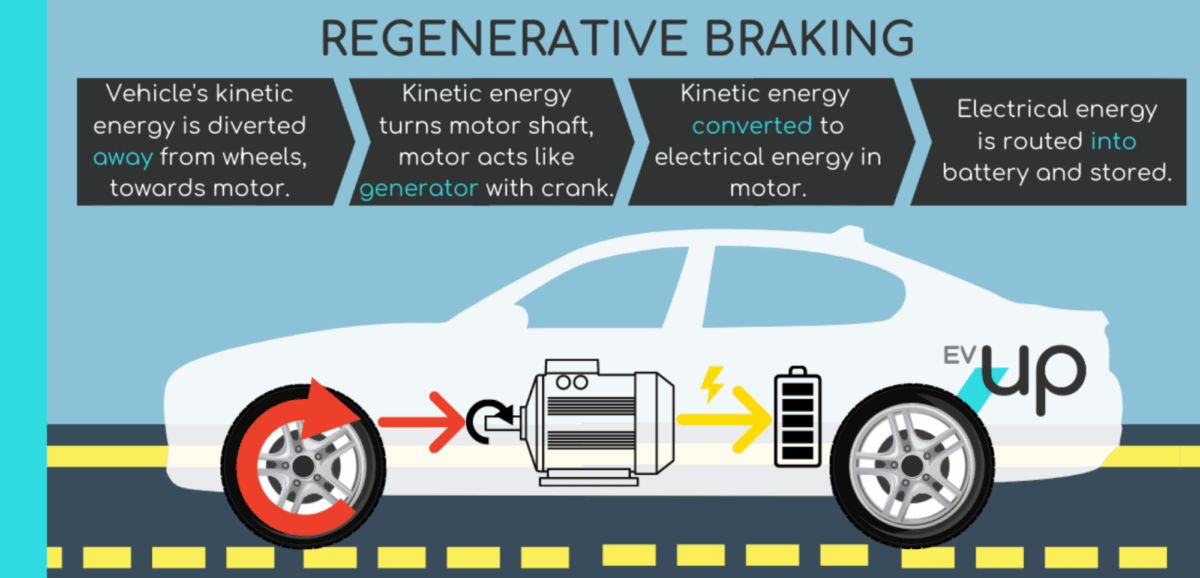
The instant your foot leaves the accelerator pedal in a modern electric car, the powertrain does something no gasoline engine can: it reverses its role. The same permanent-magnet or induction motors that were pushing the car forward now flip into generator mode. The wheels, still spinning from inertia, are suddenly met with strong electromagnetic resistance. That resistance creates torque in the opposite direction—decelerating the vehicle—while simultaneously inducing current in the motor windings.
An inverter immediately converts that wild three-phase AC into precisely controlled DC, which is fed straight into the high-voltage battery through the same power electronics that normally draw current out. The harder the motor resists (stronger regen setting), the more aggressively the car slows and the faster electrons flow back into the pack. The entire process happens in milliseconds, with almost no mechanical wear, and the only clues are a subtle rise in the battery percentage and the complete absence of brake-pedal use.
Turning Waste into Miles
In a conventional internal-combustion vehicle, roughly 60–80 % of the fuel’s energy is lost before it ever reaches the wheels, and of what does arrive, most is thrown away again as heat every time the brakes are applied. In dense city driving, that repeated acceleration–brake–accelerate cycle can waste more than half the fuel burned.
Regenerative braking attacks the biggest single loss point in the entire drivetrain. Instead of dissipating kinetic energy as useless heat through friction, it converts it back into stored chemical energy at 85–95 % efficiency across the motor, inverter, and battery. The laws of physics still demand a penalty—there is no free lunch—but the penalty shrinks from “almost everything” to “almost nothing.” What was once the largest energy sink becomes the second-largest energy source after the wall plug.

How Much Energy Actually Comes Back
Real-world 2025 vehicles routinely recapture 35–45 % of braking energy in heavy urban traffic. On the WLTP city cycle, that translates to an effective efficiency of well over 4 miles per kWh even in cold weather. In mixed driving the figure drops to 25–35 %, yet that is still enough to add 60–100 real-world miles to a 300-mile-range EV without ever plugging in.
On long descents—think the Alps, the Rockies, or California’s Grapevine—modern EVs regularly gain 15–25 kWh coming downhill, sometimes arriving with 10–20 % more charge than at the summit. Tesla owners descending from Eisenhower Tunnel to Denver have documented gaining 70–90 miles of range in a single 30-minute drop. The battery that was 48 % at the top reads 78 % at the bottom, entirely from gravity and regenerated braking.
From Clunky Beginnings to Invisible Perfection
The first Nissan Leaf and early Tesla Roadster offered only fixed, aggressive regen that felt like hitting an invisible wall when you lifted off. If the battery was cold or nearly full, the car simply refused to slow, forcing the driver to use friction brakes and wasting the opportunity.
By 2025 the technology has become extraordinarily sophisticated. Forward-facing cameras, millimeter-wave radar, high-precision GPS, and crowd-sourced traffic data allow the car to predict the exact moment a traffic light will turn red or a vehicle ahead will slow—often five to ten seconds before the driver reacts. The powertrain begins gentle regeneration in advance, harvesting energy that would otherwise be lost entirely. Brake-by-wire systems now blend regenerative and friction braking with sub-10-millisecond precision, so the pedal feel remains perfectly linear even as the balance between the two sources shifts dozens of times per minute. In quad-motor vehicles like the Rivian R1T or the upcoming BMW i5 M, each corner can regenerate independently, clawing back energy during cornering or opposite-lock slides that would be impossible in a conventional car.
The Addictive Feel of One-Pedal Driving
After a few days most drivers never touch the brake pedal except for the final inch to a complete stop or in emergencies. The right foot now controls almost the entire speed range from 100 mph to 0 simply by modulation of the accelerator. Lift slightly for gentle deceleration, lift fully for aggressive slowing that triggers the brake lights automatically above 0.3 g. The sensation is so intuitive that returning to a gasoline car feels broken—lifting off the throttle produces almost no engine braking, and the vehicle sails onward as if on ice. The muscle memory rewires itself: slowing down no longer means “press left pedal,” it means “ease right pedal.”
The Bonus That Keeps Giving
Because friction brakes are used so rarely, brake pads and rotors experience almost no wear. Independent studies of Tesla Model 3 taxis with over 300,000 miles routinely show front pads still at 70–90 % thickness. Some service centers report performing their first brake-pad replacement on customer cars at 400,000–500,000 miles. The reduced brake dust also means cleaner wheels and far less particulate pollution in cities—a hidden environmental win few people talk about.

Why It Matters—And Why It Will Matter Even More
Regenerative braking started as an engineering necessity to compensate for small, expensive batteries. It has quietly become the foundational advantage of electrification. It is the reason EVs achieve 3–5 times the tank-to-wheel efficiency of the best gasoline hybrids in real city driving. It is the reason brake maintenance budgets have collapsed. And in the coming decade it will become something far larger: the moment millions of drivers lift their feet in rush-hour traffic across a continent, they will collectively generate gigawatts of clean, dispatchable power fed back through bidirectional chargers into homes and the grid. The same motion that once wasted energy will help balance renewable intermittency at scale.
Every slowdown, every red light, every descent is no longer a loss. It is a quiet, continuous harvest of electricity—literally—the energy of motion, turned back into electricity by nothing more than the gentle lift of a foot from the accelerator.