
(Lone Star Edition: Heat-Proof, Grid-Smart, Solar-Powered, Rebate-Maximized)

Texas is going electric fast. With EV sales up 25% in 2025, more drivers are trading gas for clean, quiet power—perfect for long hauls from Houston to Dallas or weekend escapes to the Hill Country. But public charging? Spotty in rural areas and pricey during peak summer heat. The fix: a Level 2 home charger. It delivers full overnight charges, cuts your bill by 70%, and pays for itself in 12–18 months.
This guide is built 100% for Texas—scorching summers, ERCOT grid quirks, solar goldmine, and rebates that can drop your cost to $0–$400. No fluff. Just clear, actionable steps for a safe, future-proof install.
Why Install a Home Charger in Texas?
- Full charge by morning: 4–10 hours vs. 40+ on a standard outlet.
- 70% cheaper than public stations: $0.10–$0.15/kWh at home vs. $0.40+ on the road.
- Beat the heat: Charge off-peak to avoid 100°F+ grid strain.
- Boost home value: Adds 3–5% in hot markets like Austin and Dallas.
- Grid-friendly: Off-peak charging stabilizes ERCOT and unlocks rebates.
85% of Texas EV charging happens at home. Installers are booking 4–8 weeks out—start now.
The 5 Best Level 2 Chargers for Texas Homes (2025)
All are heat-rated (110°F+), weatherproof, and app-smart for TOU scheduling.
- Tesla Universal Wall Connector – $595 Works with every EV (NACS + J1772, no adapters). Wi-Fi scheduling, 48A (11.5 kW), 24 ft cable. Sleek, durable, future-proof. Best overall.
- Emporia Pro – $500 Includes free load management—monitors your AC, dryer, and charger to prevent overloads. 48A, slim cable, rock-solid app. Best value.
- ChargePoint Home Flex – $700 Auto-applies Texas utility rebates. Voice control, 50A (12 kW), 23 ft cable. Thrives in humid Houston summers. Best for rebate stacking.
- Autel MaxiCharger AC Lite – $569 Ultra-flexible cable stays soft in 100°F heat. Alexa/Google control, 48A, 24.6 ft. Best for daily ease.
- Wallbox Pulsar Plus – $649 Compact (8.7″ tall) for tight garages or condos. Dynamic load balancing, HOA-friendly billing, 48A, 25 ft. Best for shared panels.
Warning: Avoid cheap, non-branded, or untested/unlicensed chargers. They overheat, fail within months, and can start electrical fires—especially in Texas heat.
How Much Will It Cost in Texas? (2025 Averages)
Disclaimer: Every house is unique—panel age, wiring runs, charger location, HOA rules, and difficulty can swing costs $500–$2,000+ in either direction. The numbers below are statewide averages from thousands of installs. Your quote may be lower or higher. Contact us for a free, no-surprise estimate.
Statewide average: $1,000–$1,400 (slightly below national thanks to competition).
- Easy (existing 240V nearby): $500–$900
- Standard (new circuit, <50 ft): $9,00–$1,300
- Complex (panel upgrade, long runs): $1,800–$3,500+
- Urban/HOA add-on: +$200–$500
Breakdown:
- Charger: ~$580
- Labor: ~$400–$600
- Wiring: ~$300
- Permit: ~$100–$200
- Panel upgrade: $1,500–$3,000
Texas Rebates & Incentives (Valid October 30, 2025)
Federal $7,500 EV credit? Gone. But the 30% charger credit (up to $1,000) runs through June 30, 2026—and stacks with Texas utilities.
- Federal 30C Credit: Up to $1,000 (30% of install). File on taxes.
- Austin Energy: Up to $1,200 (50% off)—we file for you.
- Oncor (DFW): $500 flat.
- CenterPoint (Houston): $250–$500.
- TXU Energy: Free charging 7 PM–1 PM next day (share driving data).
- Other utilities: $250–$500 (most qualify).
- Panel upgrades: 30% federal credit (up to $600) through Dec 31, 2025.
Net cost after max rebates: $0–$400—especially in Austin.
Step-by-Step Installation: Texas Edition
DIY is illegal, voids every rebate, and can burn your house down. Texas law requires a TDLR-licensed electrician for 240V circuits. One wrong connection under 100°F heat can spark a fire that spreads in minutes—insurance won’t cover it. Hire a pro. Period.

1. Check Your Panel (Texas Reality Check – The Make-or-Break Step)
Your home’s electrical service panel is the gatekeeper—it decides if you can safely run a 48A Level 2 charger without tripping breakers or needing a $3,000 upgrade. In Texas, 1 in 4 homes (especially pre-1980 ranches and 90s subdivisions) fail this check and require work.
Panel Age = Capacity Clue
- Pre-1980 homes:
- Usually 100A main service (tiny box, old fuses or breakers).
- Problem: After AC (30A), water heater (25A), and dryer (30A), you’re left with ~15A spare—not enough for a 48A charger (needs 60A breaker + full panel capacity to support it).
- Fix: Full panel upgrade or load management (more below).
- 1980–2000 homes:
- Typically 150–200A service (bigger box, more breaker slots).
- Good news: Handles 48A charger fine in most cases.
- Catch: Summer AC load spikes—run a load calculation to confirm.
- 2000+ homes:
- 200A+ standard (modern, spacious panels).
- Plug-and-play for 48A+ chargers.
- Still check: Some builders skimped on spare capacity.
The NEC Math You Need
A 48A charger draws 11.5 kW continuous
→ NEC 625.42 requires:
- 60A dedicated breaker (125% continuous load rule – 48A × 1.25 = 60A).
Panel capacity is governed by NEC 220.82 optional dwelling calculation:
- General loads (lights, outlets, appliances): 100% of first 10 kVA + 40% of remainder.
- Largest motor (usually AC): +25%.
- EV charger: 100% of rated load (11.5 kVA).
Example (200A panel):
- General loads: 15 kVA
- AC (5-ton): 25A = 6 kVA
- EV charger: 11.5 kVA → Total calculated demand: ~28 kVA = 116A → fits under 200A.
But: If your existing demand is already 180A, adding 48A pushes you over—upgrade or load management required.
Load Management: Skip the Upgrade
- Emporia Pro (our #2 pick) includes free CT clamps—sensors that watch your whole house.
- When AC kicks on, it dials charger down from 48A → 20A automatically.
- Result: No tripped breakers, no $2,000 panel upgrade.
- Works on smaller panels in 70% of cases.
We Make This Easy
We offer a free load assessment—contact us with your panel details (photo or specs), and we’ll run the NEC 220.82 calculation and tell you:
- Green light: Install tomorrow.
- Yellow: Load management needed.
- Red: Panel upgrade quote included.
No guesswork. No surprise bills.
2. Pick the Spot – The “No Cable Stretch” Step
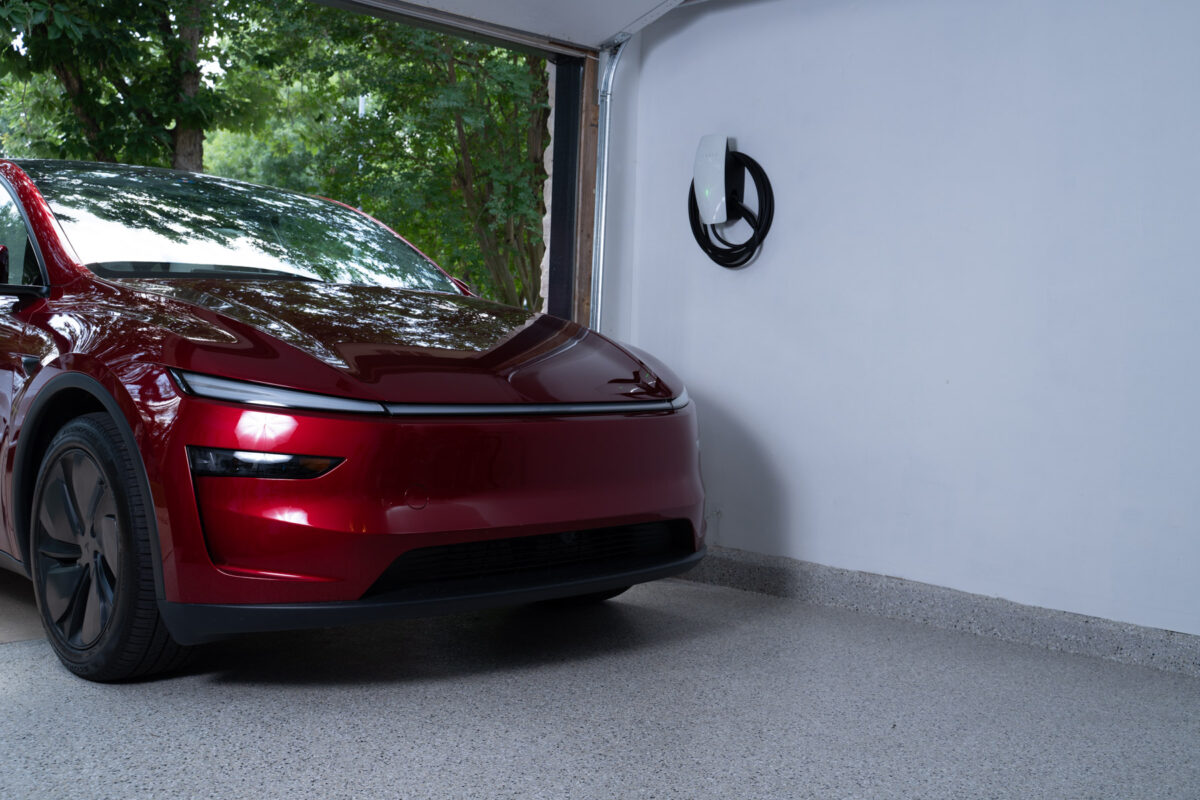
Your charger’s cable is the leash—get this wrong and you’re yanking plugs, buying $200 extenders, or parking crooked forever. Most Level 2 cables max out at 23–25 ft (hard limit—don’t trust “longer” claims). Plan like a pro.
The 20-Foot Rule
- Measure from your EV’s charge port (driver-side rear on most) to the charger mount point.
- Add 3–5 ft slack for wrapping, cold-weather stiffness, and future EVs with ports on the other side.
- Result: Mount within 18–20 ft of where the car parks—23 ft cable = safe.
Pro tip: Park your EV exactly where you want it daily. Run a tape measure from port to wall. If over 20 ft → move the mount or pick a longer-cable charger (Autel = 24.6 ft, Wallbox = 25 ft).
Garage vs. Outdoors – Texas Edition
- Garage (90% of installs):
- Cool, shaded, secure—cable lasts 10+ years.
- Avoid direct AC exhaust—heat derates charger 10–15%.
- Outdoors (driveway, carport):
- All our chargers are fully weatherproof (NEMA 3R+ rated for rain, dust, 110°F+). No upgrades required—they’ll work reliably exposed.
- Optional upgrades make sense to extend life 2–3x:
- $50 sun/rain hood → blocks UV rays (prevents cable cracking in 2–3 years) and rain pooling on connector.
- $75 pedestal mount → lifts unit off hot concrete (drops internal temp 20°F, prevents heat-soak failure).
- Heat-specific add-on: $30–$50 shade screen or awning → keeps charger under 100°F internal (Texas sun can push 140°F on black plastic → derates output 15–20% and ages electronics).
- Houston flood zone? Elevate 18″ above grade (NEC + local code) → avoids silt/water damage.
- Rural dust? Hose off monthly—grit wears J1772 pins.
3. Permits & Inspection – The “Know Your Local Rules” Step
Your EV charger is the biggest single load in your house—11.5 kW continuous, more than your AC or dryer. One mistake = melted wire, tripped breakers, or fire. Permits and inspections are your insurance policy that it’s up to NEC code and done right the first time.
In Texas, a permit is almost always required for 240V installs (TDLR rule), but final inspection isn’t universal—it depends on your city or county. Skipping either = fines, denied rebates, voided insurance, and fire risk.
What Permits Do You Need?
A statewide permit is not required, but a local electrical permit is mandatory because the installation involves electrical work.
- Local City/County Add-Ons: $50–$150
- Austin, Houston, San Antonio, DFW cities: Permit + inspection required.
- Small towns & rural counties: Permit only—no final inspection in ~40% of Texas.
- Unincorporated areas: $50 flat, self-certified by electrician.
Depending on the scope of the work, additional permits like a meter loop service permit may be necessary.
Total permit cost: $150–$350 on average.
The Inspection Process (When Required)
- Rough-In Inspection (before covering conduit/wire):
- Checks 6-gauge copper, 60A breaker, conduit type, grounding.
- Final Inspection (after charger is mounted):
- Tests voltage, load, emergency disconnect (if needed).
- Pass = green sticker. Fail = $150–$300 re-inspection fee.
No inspection? Electrician submits affidavit of compliance with permit.
Why This Matters for the Biggest Load in Your House
- 11.5 kW continuous = 48A at 240V → more than your AC.
- Wrong wire size = overheating, fire.
- Bad grounding = shock risk.
- No permit/inspection = insurance denies fire claim.
- Done right = safe, fast, rebate-eligible.
Common Permit Pitfalls in Texas
- HOA/Condo: Need board approval letter + load study before permit.
- Rural trenching: Long runs require 811 locate + easement check.
- Solar + EV: Separate interconnection permit.
- Bidirectional: Extra utility approval.
We Handle This For You
When you contact us:
- We check your local rules (inspection or not).
- Pull permits in your name.
- Schedule inspections (if needed).
- Guarantee first-time compliance (or we fix it free).
- Submit rebate paperwork with proof.
No city hall runaround. No surprise fees. Your biggest load—done perfectly.
Texas Survival Guide: Heat, Grid, Solar & More

Beat the Heat
- Charge to max 80%—Texas sun degrades batteries faster.
- Why? Parked in 100°F+ sun = 140°F+ inside the car
- → battery pack soaks up heat like a sponge.
- High voltage stress (100% charge) + high temps = chemical breakdown 2–3x faster.
- Cells form lithium plating → permanent capacity loss.
- Result: Lose 3–5% range per year vs. 1–2% in cooler climates.
- Set to 80% keeps the battery at lower voltage—the sweet spot for longevity:
- 20–30% longer battery life over 150k+ miles.
- Bonus: Faster charging (0–80% is quicker than 80–100%).
- Why? Parked in 100°F+ sun = 140°F+ inside the car
- Pre-cool cabin via app: Use your EV’s mobile app to turn on AC while plugged in.
- Car cools to 75°F using wall power, not battery → zero range loss.
- Example: Park at 4 PM → app → “Precondition” → hop in at 4:15, cool and full range.
- Weatherproof everything—avoid sun-baked cables and batteries.
ERCOT Grid Smarts
- Charge 10 PM–6 AM—avoids spikes, saves 50%, stabilizes grid.
- Emporia Pro auto-adjusts during peaks.
- Why it matters: ERCOT faces 70 GW more demand by 2028. Unmanaged daytime charging = blackouts.
- Smart shifting has prevented EEA3 rolling outages in heatwaves.
- Enroll in VPP programs → earn $100–$500/year for letting ERCOT tap your battery during peaks.
Solar + EV: Texas Gold Standard
Texas has 365 sunny days—perfect for zero-cost charging. Pair your Level 2 charger with rooftop solar and you’re running on free electrons.
- How It Works:
- Panels produce 6–12 kW during peak sun (11 AM–4 PM).
- Excess goes to your EV first → full charge in 3–5 hours using 100% solar.
- No excess? Charger pulls from grid at off-peak rates.
- Smart Integration:
- Emporia Pro and Wallbox Pulsar Plus have “solar-aware” mode—only draw when panels are producing.
- Result: $0 electricity bill for 30–50 miles/day.
- Bidirectional Bonus:
- Solar fills EV to 80% by 4 PM.
- At 5 PM peak, EV feeds 5–7 kW back to house (AC, fridge, lights).
- Refill overnight at $0.08/kWh → net zero grid use.
- Best chargers:
- Wallbox Quasar 2 ($4,000, 11.5 kW) – any CCS EV.
- Ford Charge Station Pro (free with F-150 Lightning) – 11.3 kW, 3–10 day backup.
- Emporia V2H (Q4 2025, ~$1,800) – budget-friendly.
- Tesla Powershare ($2,000–$4,000 install) – Cybertruck-exclusive, 11.5 kW continuous, integrates with Powerwall.
- Rebates & Payback:
- Federal ITC: 30% off solar + charger combo (no cap).
- Local incentives: Up to $2,500 in Austin, Houston, DFW.
- Payback: 4–6 years (faster with bidirectional).
- Pro Setup:
- 10 kW solar system + 48A charger = 60+ miles/day free.
- Add Powerwall or EV battery → full home backup during Beryl-style outages.
Bottom line: In Texas, solar + Level 2 = energy independence. Charge free by day, power your home at night, and laugh at ERCOT peaks.
Mistakes That Burn Cash—or Your House—in Texas
- Skipping panel check—1 in 4 older homes overload.
- Charging at peak—double rates + grid stress.
- No shade—15% speed loss in 100°F.
- small circuit—no room to grow.
- Charge up to 100% —shortens battery life.
- DIY wiring—illegal, voids rebates, and can start a fire that burns your house down in minutes.
Pro Texas Tips
- Always install 60A circuit—handles future EVs.
- Use TOU plans: $0.08/kWh nights—50% off.
- Solar? Charge free midday.
- Battery health: Set 80% limit, precondition in shade.
Final Texas Verdict
A Level 2 charger is your EV’s best upgrade—saving $1,000+ yearly on long Texas drives. With rebates and solar, net cost hits $0 and your fuel is free forever. It pays back in fuel savings alone within 18 months.
Start Here:
Contact us for your free load assessment—we’ll run NEC 220.82 and tell you exactly what you need.
— THOR, EV Charging Expert | 2000+ Installs Since 2021 Last updated: October 29, 2025
Disclaimer: Always hire a licensed electrician. Local codes vary. Data based on U.S. NEC 2023 and real-world installs in TX