
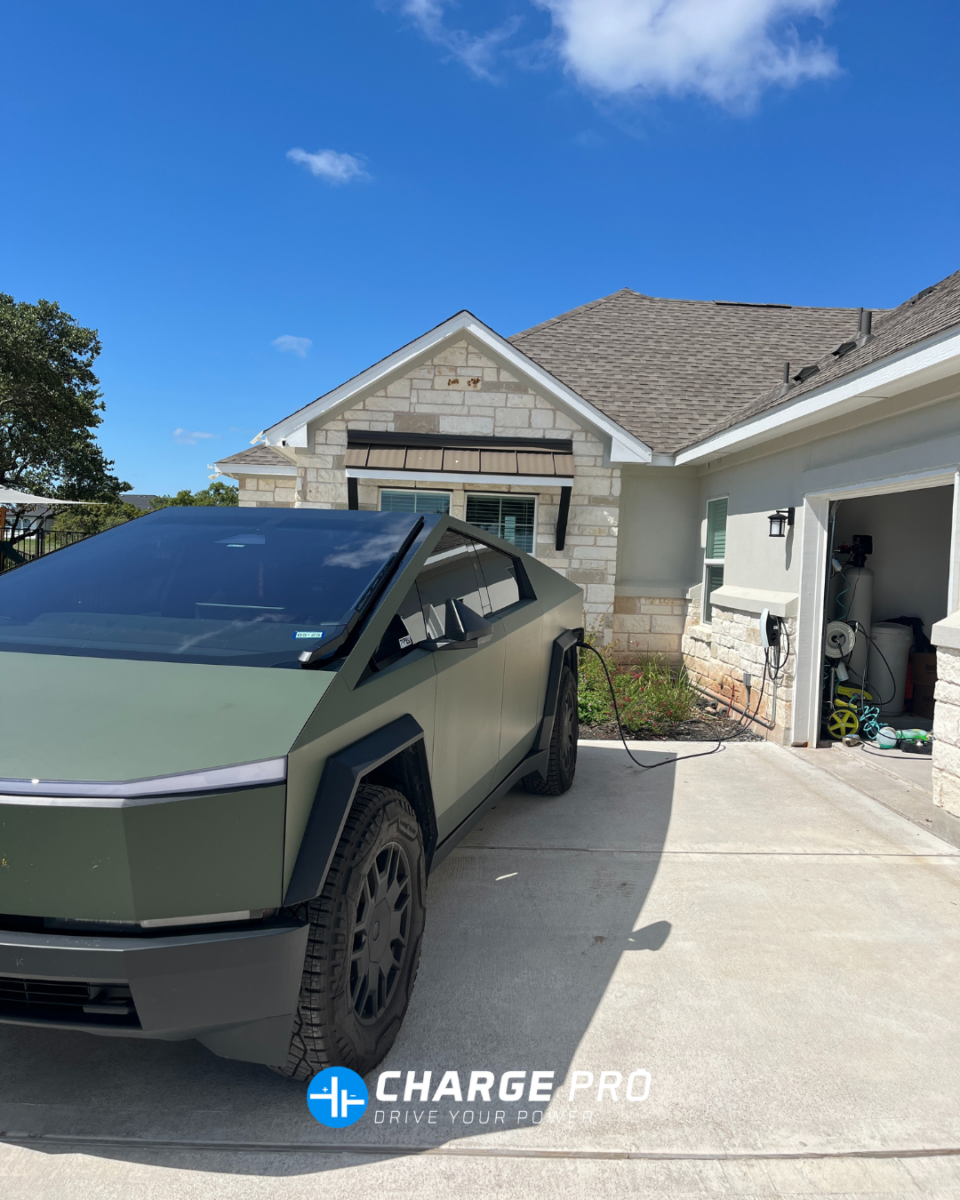
As electric vehicles continue to grow in popularity across Texas, more homeowners are asking the same question:
How much does it cost to install an EV charger at home?
While public charging networks are expanding quickly, most EV owners prefer the convenience of charging at home. A professionally installed Level 2 charger allows drivers to plug in overnight and start each day with a full battery.
In this guide, we’ll break down the real cost of EV charger installation in Texas in 2026, including equipment, installation, electrical upgrades, and available rebates.
Average EV Charger Installation Cost in Texas
For most homes in Texas, installing a Level 2 EV charger typically costs:
$1,200 – $3,000 total installed
This generally includes:
- EV charger hardware
- Electrical wiring and materials
- Professional installation
- Permits and inspections
In cities like Austin, Dallas, Houston, and San Antonio, many installations fall between $1,300 and $2,500 depending on the home’s electrical setup.
The single biggest factor affecting price is usually the distance between the charger and the electrical panel.
Level 1 vs Level 2 Charging
Before installing a charger, it helps to understand the two charging options available for homes.
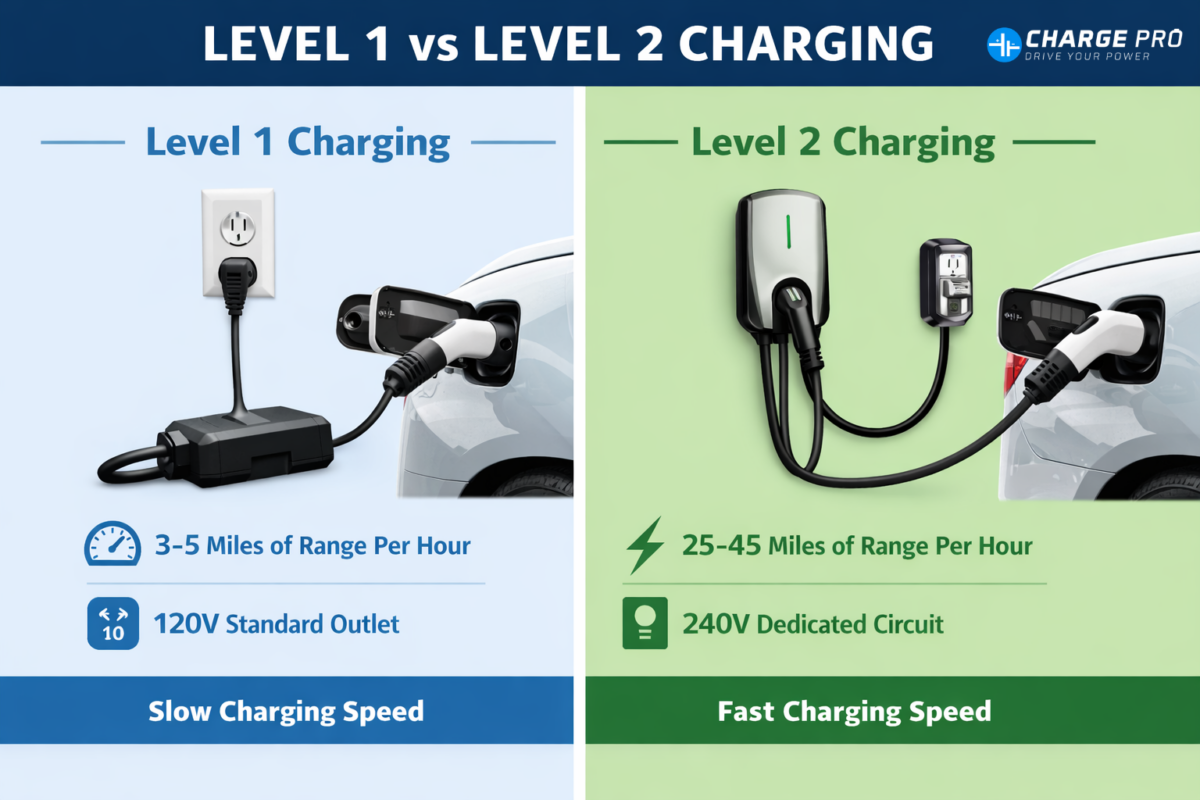
Level 1 Charging (Standard Outlet)
Level 1 charging uses a 120-volt household outlet, the same type used for most electronics.
Charging speed:
3–5 miles of range per hour
While this can work for plug-in hybrids or extremely short commutes, it is typically too slow for fully electric vehicles.
Level 2 Charging (Home Charger)
Level 2 chargers operate on 240-volt power, similar to major household appliances such as electric dryers or ovens.
Charging speed:
25–45 miles of range per hour
This allows most EVs to fully recharge overnight.
Because of the dramatically faster charging speed, Level 2 chargers are the standard solution for home EV charging.
EV Chargers vs Dryer and Oven Outlets
Since EV chargers use the same voltage as dryers and ovens, many homeowners assume they can simply plug their charger into an existing appliance outlet.
However, this is not recommended and often not compliant with electrical code.
EV chargers require a dedicated circuit specifically designed for continuous charging loads.
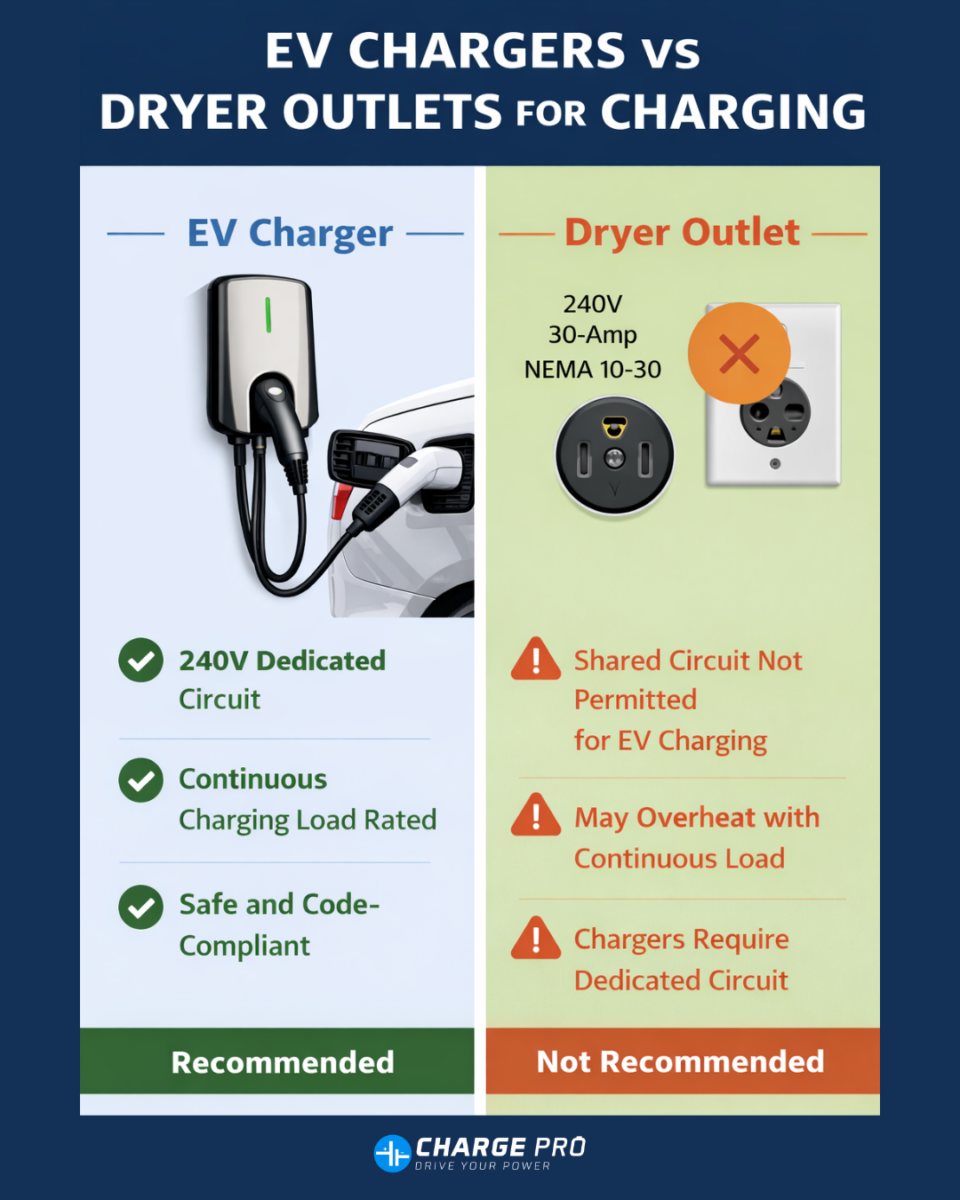
Why dryer outlets should not be used for EV charging
Electrical code requirements
The National Electrical Code requires EV chargers to be installed on a dedicated circuit, meaning the circuit cannot be shared with another appliance.
Continuous load safety
EV chargers often operate for several hours continuously. Circuits must be sized differently to safely support this type of load.
Overheating risk
Adapters, undersized wires or shared circuits can lead to overheating, damaged outlets, and tripped breakers.
A proper installation ensures the charger operates safely and reliably for years.
Should an EV Charger Be Installed From the Main Panel or a Subpanel?
In most homes, EV chargers are ideally installed directly from the main electrical service panel rather than a garage subpanel.
While a charger can technically be connected to a subpanel, garage subpanels often do not have enough available capacity to support EV charging.
Why subpanels often cannot support EV chargers
Garage subpanels typically power:
- garage outlets
- lighting
- small tools or appliances
These panels are often rated between 60 and 100 amps, and much of that capacity may already be in use.
A Level 2 charger typically requires a 40–60 amp circuit, which is considered a continuous load under electrical code.
Because of this, adding a charger to a subpanel frequently exceeds the available capacity.
Why installing from the main panel is usually preferred
Running the charger directly from the main panel provides several advantages:
More electrical capacity available
Proper load calculations and safety measures
More flexibility for future EV chargers or electrical upgrades
Installing from the main panel often eliminates the need to upgrade or reconfigure a smaller garage subpanel.
Using Load Management to Protect Electrical Panels
In some homes, installing a charger from a garage subpanel may still be possible.
Even when a subpanel technically has enough capacity, many professional installers implement load management systems to ensure the panel is never overloaded.
One solution is installing a load monitoring device such as a Neurio energy meter.
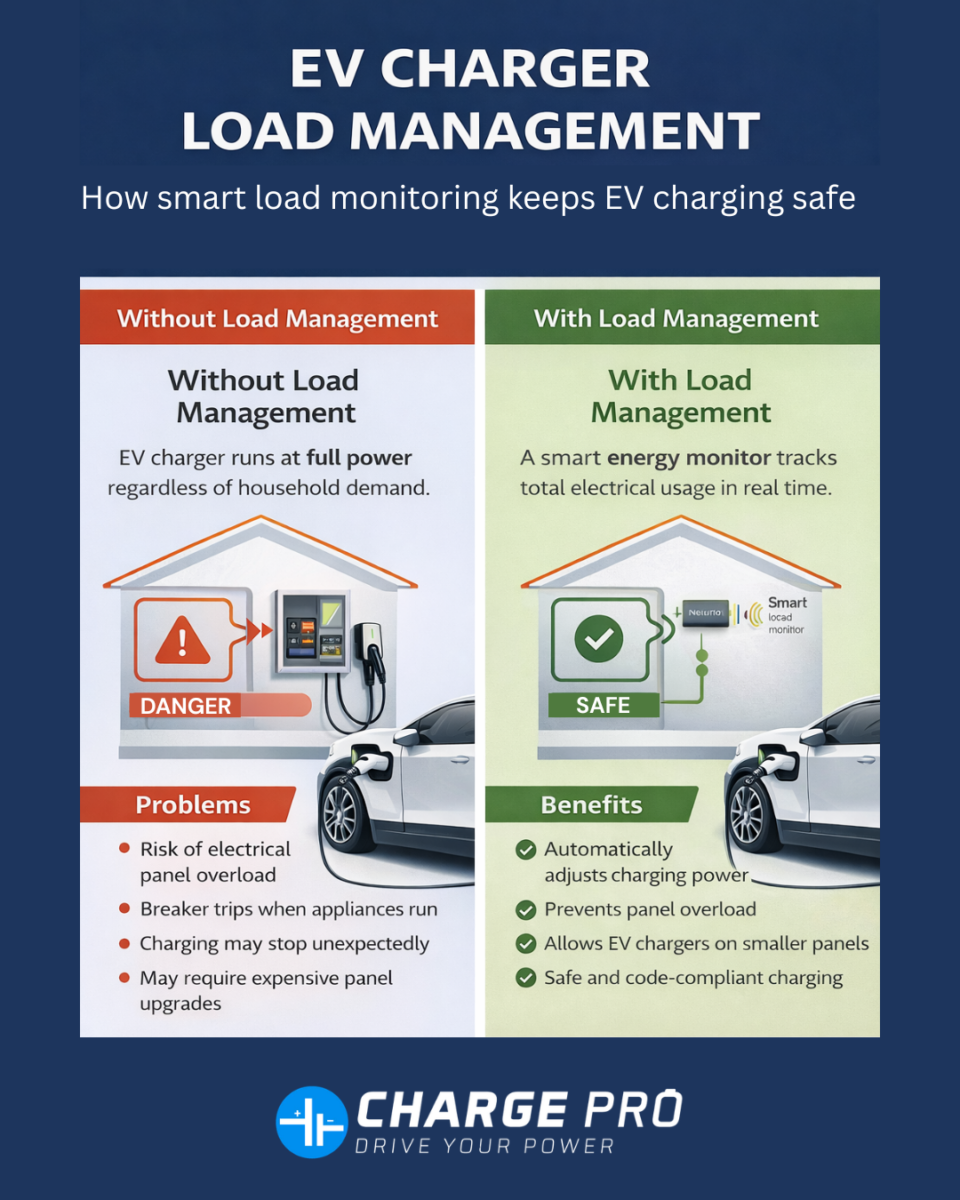
What a Neurio load monitor does
A Neurio device monitors the real-time electrical load on the panel and communicates with the EV charger.
If the home’s electrical demand approaches the panel’s capacity — for example when multiple appliances are running — the charger will automatically reduce charging power or pause charging temporarily.
This ensures the electrical system never exceeds safe limits.
Why load management is useful
Load monitoring can:
- protect the electrical panel from overload
- prevent expensive electrical upgrades
- allow EV chargers to be installed in homes with limited capacity
This approach allows homeowners to safely install EV charging without unnecessary electrical risks.
EV Charger Hardware Cost
The charger itself typically costs:
$450 – $1,200
Popular residential chargers include:
- Tesla Wall Connector
- ChargePoint Home Flex
- Emporia Smart Charger
- Car Brand Chargers
Many modern chargers include smart features such as:
- Wi-Fi connectivity
- energy monitoring
- charging schedules
- solar integration
Installation Labor Costs
Professional installation typically costs:
$500 – $1,500
Licensed electricians in Texas generally charge $100 – $150 per hour, and most installations take 2–6 hours.
Simple installations where the main electrical panel is located close to the garage tend to be the most affordable.
Electrical Panel Upgrades
Some homes may require electrical upgrades before installing an EV charger.
Typical costs include:
Load management system
$500 – $800
Subpanel installation
$800 – $1,800
Full electrical panel upgrade
$2,000 – $4,000+
Fortunately, many modern homes already have enough capacity to support EV charging.
EV Charger Installation Cost Calculator (Texas)
| Installation Scenario | Typical Cost |
|---|---|
| Simple installation (<10ft) | ~800$ |
| Standard installation (10-50 ft) | ~1300$ |
| Complex installation (50+ ft) | ~2000$+ |
| Panel upgrade required | $2,000 – $4,000+ |
Disclaimer: These prices are based on the average install and do not include the cost for the charger, permits, additional panel upgrades or load management devices. Prices may vary depending on the complexity of the install.
Typical Cost Breakdown
| Item | Typical Cost |
|---|---|
| EV charger hardware | $450 – $1,200 |
| Installation labor | $500 – $1,500 |
| Electrical materials (wire, conduit, breakers, fittings) | $150 – $600 |
| Permits and inspection | $50 – $300 |
| Total installed cost | $1,200 – $3,000 |
Federal Tax Credits and Texas Rebates
Homeowners may qualify for incentives that significantly reduce installation costs.
Federal EV Charger Tax Credit
- 30% of installation cost
- up to $1,000 tax credit
Utility Rebates
Some utilities offer additional incentives.
For example, Austin Energy offers rebates up to $1,200 for residential EV charger installations.
Checking with your local utility provider can further reduce installation costs.
EV Charger Installation FAQ
Can I install an EV charger myself?
Most Level 2 chargers require 240-volt electrical work, which should be performed by a licensed electrician to ensure safety and code compliance.
Can I plug my EV charger into a dryer outlet?
No. EV chargers must be installed on a dedicated circuit designed for continuous charging loads.
Using dryer outlets or adapters can cause overheating and electrical hazards.
Do I need to upgrade my electrical panel?
Not always. Many homes already have enough electrical capacity. An electrician can perform a load calculation to determine whether upgrades are required.
How long does EV charger installation take?
Most installations take 2–6 hours depending on wiring complexity.
Does installing an EV charger increase home value?
Yes. As EV adoption grows, homes equipped with EV charging infrastructure are becoming more attractive to buyers.
Final Thoughts
For most homeowners in Texas, installing a Level 2 EV charger costs between $1,200 and $3,000 depending on the home’s electrical setup.
With federal tax credits and utility rebates available, the effective cost can often be significantly lower.
As electric vehicles become more common across Texas, installing home charging infrastructure is quickly becoming a standard upgrade for modern homes.
When installed correctly, a home EV charger provides one of the most convenient and cost-effective ways to power your vehicle.