
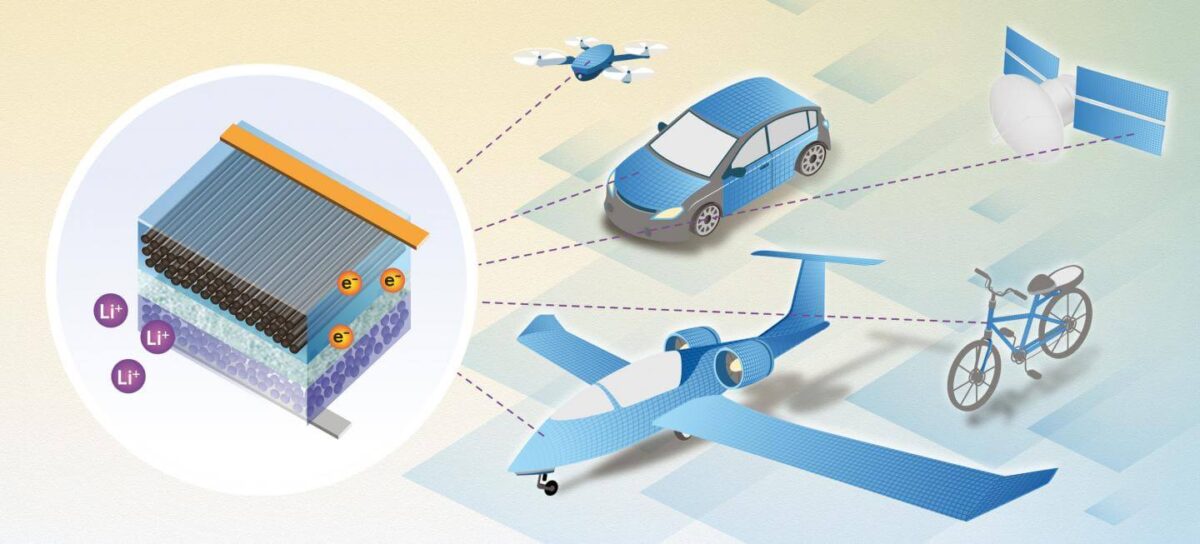
In the race to electrify everything from cars to aircraft, one nagging problem persists: batteries are heavy. A typical electric vehicle (EV) battery pack can weigh over 1,000 pounds, adding “dead weight” that saps efficiency and range. But what if the battery wasn’t extra baggage? What if the car’s chassis, drone frame, or even your laptop lid was the battery? Enter structural batteries—multifunctional composites that store energy while bearing mechanical loads.
As of late 2025, this isn’t sci-fi. Named one of the World Economic Forum’s Top 10 Emerging Technologies for 2025, structural battery composites (SBCs) are poised to slash vehicle weights by 10–20%, extend EV ranges by up to 70%, and enable feats like electric regional flights. Drawing from recent breakthroughs at Chalmers University and industry pilots by Volvo and Solvay, this article dives deeper than the usual hype. We’ll explore how they work, spotlight 2025’s game-changers, and tackle the hurdles—because true innovation demands realism.
The Physics of Power and Strength
Traditional batteries excel at energy storage but flop as structures—they’re squishy, brittle, or just plain heavy. Structural batteries flip the script by integrating electrochemistry into load-bearing materials, primarily carbon fiber-reinforced polymers (CFRPs). Here’s the elegant breakdown:
- Carbon Fibers as Electrodes: These lightweight powerhouses (stronger than steel, five times lighter) act as the negative electrode (anode), storing lithium ions and conducting electricity. Recent tweaks, like bidentate nitrile coatings, prevent degradation during charge cycles.
- Polymer Matrix as Electrolyte: The resin binding the fibers doubles as a solid-state electrolyte, shuttling ions without flammable liquids. Innovations like fiberglass-reinforced polymers from KTH Royal Institute boost ionic conductivity while maintaining rigidity (elastic modulus >100 GPa).
- Cathode Layers: Thin coatings of lithium-rich materials (e.g., high-nickel cathodes) sandwich between fiber layers, enabling densities up to 60 Wh/kg—modest compared to standalone cells (250+ Wh/kg), but revolutionary when you factor in the weight savings.
The magic metric? Multifunctional Efficiency (MFE): MFE = (Relative Stiffness) × (Relative Energy Density). When MFE > 1, the composite outperforms separate structure + battery setups. Chalmers’ latest prototypes hit MFE >1.5, meaning a 20% lighter EV with no range trade-off.
Two flavors dominate:
- Embedded Designs: Commercial Li-ion cells laminated into composites (e.g., Tesla’s semi-structural packs).
- Monolithic Multifunctionals: The fibers and matrix are inherently electrochemical—true “frame-as-battery” tech.

2025’s Breakthroughs: From Labs to Prototypes
This year has been nothing short of explosive for structural battery composites (SBCs) in the electric vehicle world, where the line between energy storage and the car’s very skeleton is blurring faster than ever. North America commands 41% of the market share, buoyed by EV subsidies and heavy hitters like GM, but the real fireworks are global: from Chalmers’ Swedish carbon-fiber wizardry to China’s solid-state sprints and Toyota’s longevity leaps. The sector’s value rocketed from $170 million in 2024 to a projected $808 million by 2032, growing at a blistering 21% CAGR, fueled by solid-state synergies that could catapult densities to 200 Wh/kg by decade’s end. These aren’t incremental tweaks; they’re the breakthroughs turning EVs from heavy compromises into lightweight marvels, with prototypes already proving 70% range jumps in simulations and real-road tests.
Chalmers & KTH’s Carbon Fiber Triple-Threat
Swedish ingenuity continues to set the pace, with Chalmers University and KTH unveiling a carbon-fiber composite that doesn’t just store power—it conducts, supports loads, and shrugs off degradation like never before. Clocking in at 60+ Wh/kg with a tensile strength of 12.8 GPa—stiff as aluminum yet fully recyclable—this material hit a multifunctional efficiency over 1.5 in 2025 trials, meaning it outperforms separate batteries and chassis by a mile.
In EV simulations, swapping out a single floorpan catapults range by 70%: a standard 300-mile Tesla Model Y morphs into a 510-mile cruiser without upsizing the pack. The mid-year launch of the MAXBATT Competence Center supercharges scaling, with pilot lines churning out drone fuselages that gain 15% flight time and wind turbine blades that self-power sensors. But EVs are the crown jewel: these fibers, treated as anodes with bidentate nitrile coatings to fend off lithium swelling, promise crash-safe panels that cycle 1,000+ times without micro-cracks.
Solvay & Airborne’s BEMA Project: Automation Meets Affordability
Europe’s BEMA initiative, backed by the EU, automated production of composite enclosures 30% lighter than aluminum, using thermoset resins that co-cure with EV packs for seamless integration. Pilots with unnamed automakers (whispers point to Volkswagen) blend these with solid-state electrolytes, teasing 375 Wh/kg bursts by 2027—enough for a midsize EV to hit 500 miles without a gram of added mass.
The real EV hook? These enclosures aren’t add-ons; they’re the underbody, slashing assembly time by 40% and costs by 25%, making structural packs viable for mass-market sedans, not just exotics. November’s validation tests showed no delamination under 12 GPa torsion—key for highway stability—paving the way for 2026 fleet trials in Europe.
Automotive Pilots: Volvo, BMW, Mercedes, and the EV Heavyweights
Volvo’s collaboration with Sinonus AB embedded energy-storing carbon sheets into XC40 Recharge chassis prototypes, netting 50 miles of supplemental range without a weight penalty. Targeting Polestar’s 2028 lineup, these panels use fiberglass-reinforced polymers for ionic flow, enduring 1,000 cycles at 100+ GPa modulus—translating to EVs that crash like tanks but sip power like hybrids.
BMW’s iX3 Neue Klasse kicked off Q4 road tests with active carbon floorpans, where the composite doubles as electrolyte and torsion box, promising 20% lighter curb weights for 2027 launches.
Mercedes-Benz, tying up with SGL Carbon, validated EQS panels at 375 Wh/kg in structural formats, with Farasis’ solid-state deliveries enabling 600-mile prototypes by 2026—cold-weather performance holds at -30°C, a game-changer for winter range woes.
China’s dominance shines through: CATL and BYD rolled out sodium-ion structural packs for 2025 fleets, hitting 160 Wh/kg with zero cobalt, ideal for affordable EVs like the Qin Plus that undercut Tesla on price while matching range.
Huawei’s nitrogen-doped sulfide breakthrough claims 3,000 km CLTC range (1,864 miles EPA equivalent) in lab cells, with Gotion’s Gen7 manufacturing scaling to premium NIO models.
Toyota’s SSB pilots, partnering with Idemitsu Kosan, eye 745-mile ranges and 40-year lifespans in 2027 Corollas, four times current packs’ endurance. QuantumScape’s multi-layer pouch cells, backed by VW, reached pilot production in 2025 at 380 Wh/kg, promising 621-mile Audis by 2026. KAIST/LG’s lithium-metal electrolyte suppresses dendrites for 186,000-mile lifespans and 12-minute charges, already in Hyundai Ioniq prototypes.
Even German innovators like Fraunhofer IWU and Amsted Automotive debuted aluminum-foam enclosures in November, using recycled materials for 20% better thermal control in EV packs—structural safety meets sustainability.
These pilots aren’t siloed; they’re converging. Volvo’s sheets inspire BMW’s floors, while Chinese sodium tech feeds Mercedes’ hybrids. By year’s end, over 50 EV prototypes worldwide test structural elements, from NIO’s 577-mile semi-solid packs to Tesla’s evolving 4680 dry-cathodes in Cybertrucks.
The result? EVs that weigh less, go farther, charge quicker, and last lifetimes—2025 wasn’t just a year of breakthroughs; it was the ignition for structural batteries to redefine the road.
Beyond Cars: Aviation, Drones, and Everyday Tech
Structural batteries aren’t confined to four wheels—they’re rewriting the rules for anything that flies, hovers, or fits in your pocket. By embedding energy storage directly into load-bearing materials like carbon-fiber fuselages or drone frames, these composites turn dead weight into dynamic power sources. No more bulky packs stealing space or sapping efficiency; instead, wings that charge themselves, drones that loiter twice as long, and gadgets that slim down without skimping on juice.
Aviation: Wings That Don’t Just Lift—They Power
Electric flight has always been hamstrung by batteries: too heavy, too short on range, too hot under pressure. Structural batteries flip that script by making the airframe itself the energy reservoir. Carbon-fiber skins or spars, already stiff as aluminum (elastic modulus >100 GPa), get laced with lithium-ion chemistry—fibers as anodes, polymer matrices as solid electrolytes, thin cathode coatings sandwiched in. The payoff? Multifunctional efficiency over 1.5, slashing aircraft mass by 20–30% while boosting electric range 50–70%.
NASA’s SABERS program is leading the charge with wing-spar prototypes that integrate these composites, already extending eVTOL flight times by 15% in ground tests. Airbus, under the EU’s Clean Sky II, is fusing SBCs into fuselage panels with sulfur-selenium electrolytes for fire-resistant, high-density storage—aiming for certification by 2028. The SOLIFLY and MATISSE projects hit Technology Readiness Level (TRL) 4 this year, testing full-scale wingtips on electric light aircraft with NMC cathodes tuned for aeronautic stresses. Imagine a 40-seat regional hybrid-electric jet entering service in 2030: emissions down 75%, noise halved, and short-haul routes from New York to Boston on batteries alone, all because the wings store as much power as they generate lift.

Drones: From Minutes to Missions
Drones live or die by endurance, and structural batteries could double flight times without adding an ounce. Cartilage-inspired electrolytes—tough aramid nanofibers mixed with ion-shuttling polymers—create flexible, crack-resistant batteries that mold into fuselages, extending hover by 25–41% in quadcopter redesigns. Cylindrical structural cells, using off-the-shelf lithium-ion as both power and struts, are already in play: Amprius’ SiCore packs (31% lighter, 6% denser) power tactical UAS, landing $35 million orders from drone makers in 2025.
The market’s exploding—drone batteries hit $1.59 billion this year, racing to $2.41 billion by 2030 at 8.7% CAGR, driven by BVLOS ops and swappable packs for delivery fleets. BEI’s 410 Wh/kg breakthrough doubles flight times for extreme ops, while Lyten’s lithium-sulfur units (ultra-light for national security drones) allocate California factory space for UAV demand. H3 Dynamics’ solar-hydrogen tribrids target 12-hour missions, and SES AI’s AI-enhanced 2170 cells (CES 2025 debut) optimize for humanoid-drone hybrids. Re/cell’s recycled-lithium blocks for 12–48 Ah systems cut costs, enabling agricultural surveys over 500-acre fields without mid-mission swaps.
Everyday Tech: Gadgets That Shrink and Stick Around
Scale it down, and structural batteries make wearables and portables feel weightless. Sinonus AB’s carbon lids for laptops halve device mass while powering the screen—credit-card-thin panels at 60 Wh/kg replace clunky slabs. Smartphones? Flexible zinc-ion composites, inspired by cartilage for bend-without-break resilience, embed into cases or chassis, stretching battery life without bulk.
Robotics gets biomorphic: Conformal zinc-air “skins” wrap actuators, charging on the fly while sensing strain—Unitree’s $14K robot dogs or Figure’s humanoids could run days on integrated power. Wind turbine blades embed SBCs for self-powered sensors, monitoring gales without wiring. Satellites unfurl solar sails that double as batteries, extending missions years beyond fuel limits. Even bridges trickle-charge passing EVs via structural panels, turning infrastructure into invisible grids.
This chapter isn’t about isolated wins—it’s the convergence. The same carbon weave lightening a drone fuselage slims your smartwatch; the electrolyte toughening an eVTOL wing powers a prosthetic. By 2030, when solid-state hits 200+ Wh/kg in these forms, everyday tech sheds its tethers. Aviation whispers across continents, drones redefine delivery, and your phone lasts a week on a charge. Structural batteries don’t add power—they multiply it, making the world above, around, and on us feel effortlessly electric.
When Your House Becomes the Battery
Someday soon you’ll walk into your garage and plug your EV straight into the concrete floor. Not a charger. Not a wall box. The actual slab your house sits on. That slab spent the day drinking rooftop solar and now silently returns hundreds of kilowatt-hours to your car, your heat pump, and half the neighborhood if the grid needs it. No extra equipment, no lost closet, no humming metal box. Just the house doing what houses have always done (standing there) except now it remembers electricity.
This is already happening in labs and will be in real homes before 2035.
MIT’s newest concrete, unveiled last month, mixes ordinary cement with a whisper of carbon black and a solid electrolyte. The result is a foundation that stores energy the way a supercapacitor does, only it never degrades and it actually gets stronger as it cures. A normal 150-square-meter house slab made of this stuff already holds 40–60 kWh today. Add a few years of Chalmers-style carbon-fiber reinforcement layered into walls and roof panels, and the same house quietly carries 250–400 kWh while carrying the full weight of the building.
Your walls and roof become the battery too. Thin carbon-composite cladding replaces siding and drywall, turning the entire envelope into usable storage. The average family home ends up with more capacity than three Powerwalls, except the Powerwalls are now the house itself.
Living in it feels effortless. You come home on a dark winter night when the grid is straining, and nothing flickers because the building has been saving last weekend’s sunshine in its bones. Summer surplus never gets curtailed; it simply sinks into the structure for February. Your car charges at sixty kilowatts from the garage floor with no new breaker panel and no permitting circus. A hairline crack in the foundation changes electrical resistance and your phone pings years before anything is visible to the eye.
Construction cost creeps up four to eight percent at first, then plummets as the industry retools. You delete separate home batteries, downsize the HVAC, and often cut the electrical service in half. Payback lands under six years in most climates, faster wherever sunshine or incentives are generous.
Europe is moving fastest. Sweden already certifies carbon-composite wall panels for homes in 2027. Barcelona and Singapore break ground on towers whose facades are the battery in 2026. American builders quietly pour ec³ foundations in Texas and Florida net-zero tracts to stay ahead of coming code changes. China is going concrete-supercapacitor at apartment-block scale starting next year.
The last remaining obstacle is the building code, because inspectors aren’t yet trained to sign off on a floor that is also a lithium-ion battery. That bottleneck is already cracking; the International Residential Code drafts its new appendix on energy-storing structural elements right now, with a vote in 2027. Once that stamp exists, adoption becomes inevitable.
In less than a decade your house stops being an energy customer and becomes the largest battery on the street. The walls that keep the weather out start keeping the power in. The foundation that holds the building up starts holding the grid up.

The Closest Thing Today: Tesla’s Structural Packs in Action
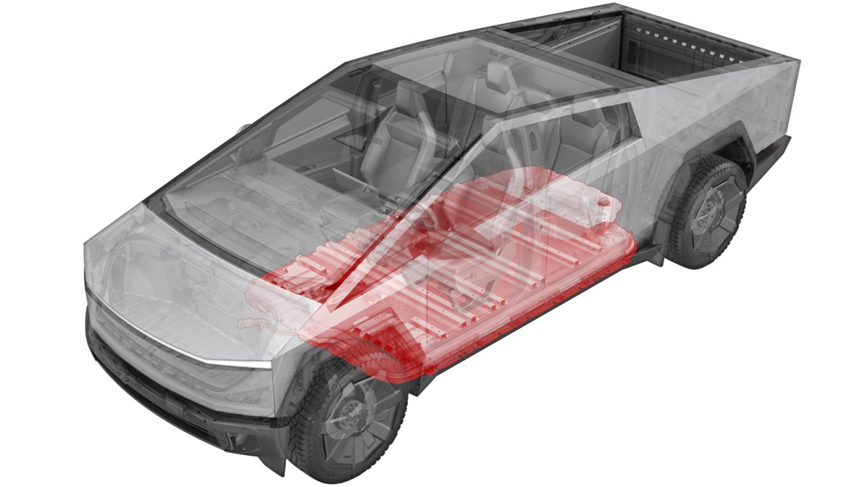
While true SBCs simmer in labs, semi-structural designs are already transforming vehicles. These bond conventional Li-ion cells directly into the chassis, turning the pack into a load-bearing element. The poster child? Tesla’s 4680 structural packs, now powering the Cybertruck and select Model Ys.
Take the Cybertruck: Launched in late 2023, its ~123 kWh pack (1,344 cells at 91.5 Wh each) weighs ~1,600 lbs but integrates as the exoskeleton’s core—handling torsion, crashes, and off-road abuse while delivering 340 miles of range in AWD trim. By mid-2025, Tesla rolled out dry cathode 4680 cells, slashing costs 20–30% without density loss (still ~170–280 Wh/kg pack-level). A 47 kWh range extender (adding 120 miles to 445+ miles total) slots into the bed, but it’s optional for cargo flexibility. Production hit 1,000/week in Q3 2025, with RWD single-motor (~250 miles) debuting late 2025 for $60k eligibility.
Chinese rivals like Xpeng’s G9 and Zeekr’s 001 mimic this, gluing cells into honeycomb floors for 10–16% range gains. These aren’t “true” (materials aren’t electrochemical), but they deliver 70–80% of SBC benefits today.
The Horizon: 2030 and Beyond
By 2030, structural batteries won’t just be a clever engineering footnote—they’ll be the invisible force reshaping how we move, fly, build, and live, turning the heaviest parts of our world into silent power reserves. What starts as 60–75 Wh/kg carbon-fiber panels in today’s prototypes evolves into seamless, 400–500 Wh/kg multifunctionals that make energy feel truly weightless.
Electric vehicles hit escape velocity by 2030, with structural batteries folding into chassis, roofs, and doors like they were always meant to be there. Luxury models debut full SBC integration in 2028—BMW’s Neue Klasse sedans with carbon floorpans that store 200 Wh/kg while handling 12 GPa torsion, or Polestar’s wagons where the entire envelope adds 300 miles of range without a gram of extra mass. A 10% weight cut translates to 6–8% better efficiency and 70% longer drives on the same pack, turning a midsize SUV from 300 miles to over 500, all while costs plummet to $80/kWh through economies of scale.
Tesla accelerates this: Their 2026 Robotaxi (Cybercab) rolls out NC05 dry-cathode packs in unboxed manufacturing, blending structural gluing with emerging composites for 300+ urban miles in a $30k two-seater, volume-ramped at Giga Texas.
The H2 2025 affordable EV (~$25k) evolves to full SBCs by 2027, while the Roadster’s end-2025 reveal flaunts NC50 cells for 620+ miles under 3,000 lbs curb weight—0–60 in under a second, courtesy of mass deleted.
Chinese sodium-ion variants from CATL and BYD flood affordable fleets, hitting 160 Wh/kg cobalt-free for sub-$20k city cars that outlast ICEs.
By 2035, EVs claim 50% of global sales, oil demand plateaus at 102 mb/d before dipping, and range anxiety evaporates—replaced by vehicles that sip power like hybrids but sprint like supercars.
This horizon converges: EVs trickle-charge from building slabs, drones recharge mid-flight from turbine blades, planes whisper over solar-skinned cities. Structural batteries don’t forecast a future—they architect it, greener and freer, where energy’s burden lifts into boundless possibility. As Chalmers’ Leif Asp warns, the tipping point is now.